What Felt Urgent
CNTRFLD. What felt most urgent—or most at stake—for you in bringing this body of work together at this point in your practice?
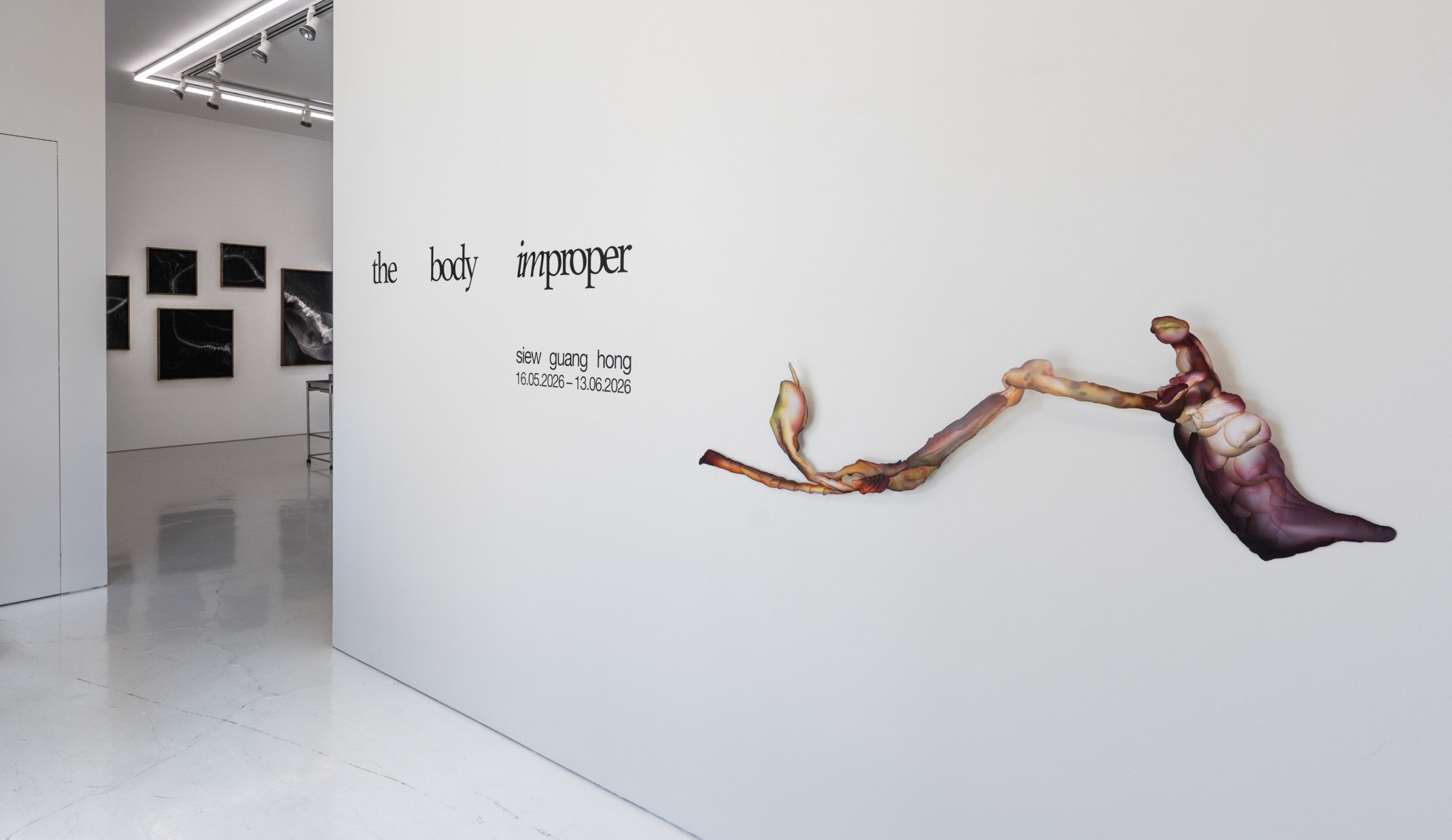
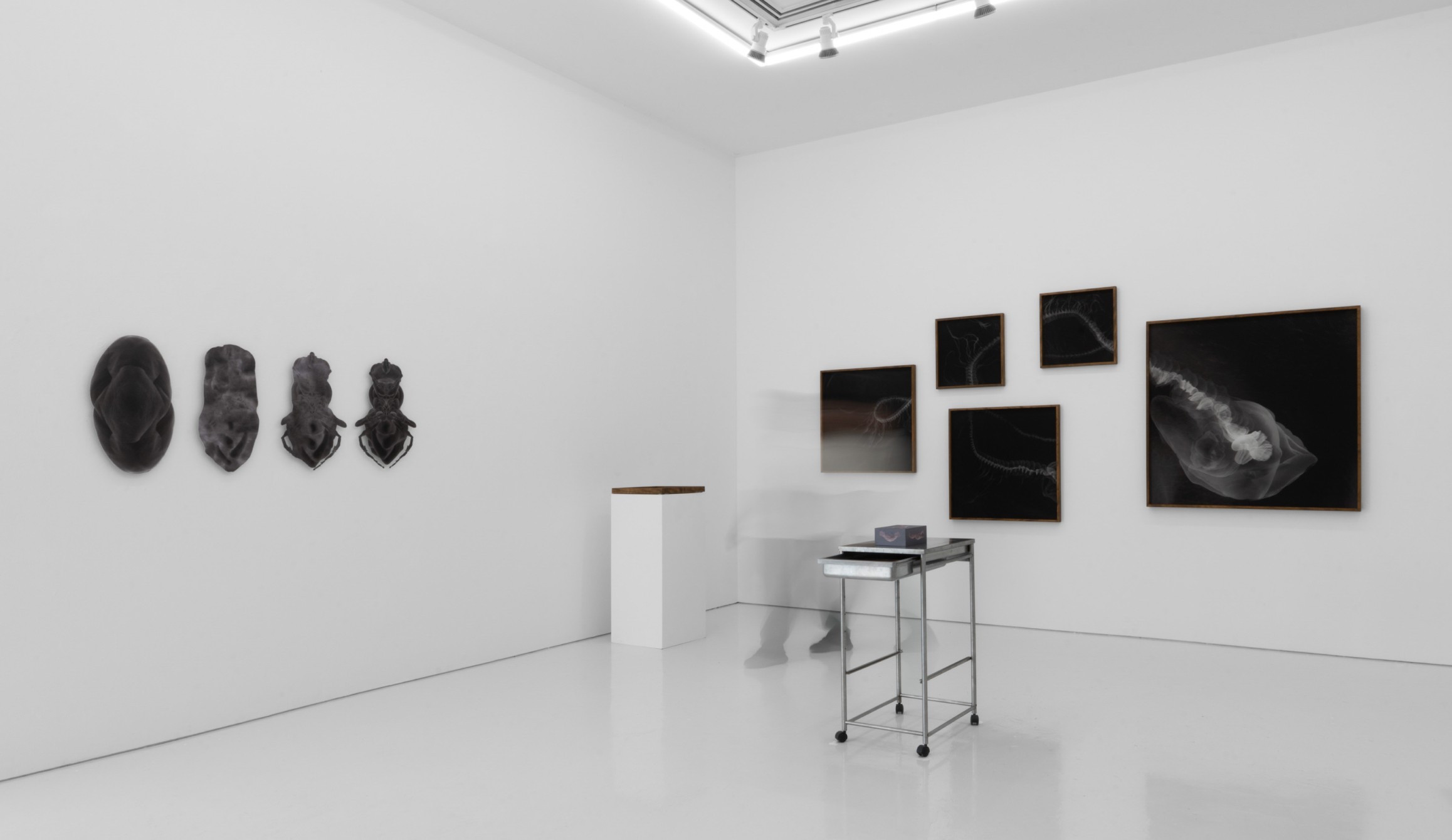
SGH. As my first solo exhibition, this was an important opportunity to bring together various strands that I have developed over the past couple of years. More practically, this show exhibits the breadth of my practice to people who have not yet been introduced to everything that I have done so far. However, on a more conceptual level, my works have always operated relationally. This is actually true for many artists, where understanding their artwork can be enriched by understanding the works that have come before and after. Despite this, there seems to be a tendency to read an artwork as “in-and-of-itself”; an essentialist tradition I believe has some roots to classical Forms discussed previously. Having the space of a solo exhibition allows me to articulate conversely immanent relationships in a more intentional manner. For example, artworks from the dancing naiad, Rounding Around and Dreaming to Fly, and Analogy series explore different themes. But assembled together, they evoke broader ecological relationships: from predator-prey dynamics to entanglements with the aquarium trade. Moving away from the self-sufficient and independent systems we often see the artwork body as, I wanted my show to more intentionally articulate a framework of contingency and audience theatricality.
Many of my interests stem from my experiences as a queer body, being oriented differently from the people around me. Growing up, I was often told that certain ways of living were unnatural or wrong. Later, as I began learning more about non-human animals and plants, I realised that the “natural” world was not so “natural” after all. While remaining grounded in LGBTQIA+ concerns, my practice therefore looks towards non-human life and ecological relationships as a way of questioning fixed ideas of human essentialism. Part of this does come from a perceived urgency and need to expand how queerness is imagined in a local context. Singapore is not the worst place to be queer, but there is still room for broader conversations about what queer art can be beyond recognisable images of LGBTQIA+ identity.
Therefore, I wanted to engage with how bodies relate, transform, and enter co-becomingness. How might our understanding of ourselves change when we encounter forms of life that do not resemble us? Even other humans that don’t resemble us, physically or otherwise. And how might this reshape our relationships to animals, plants, landscapes, and the many other beings with whom we share the world? For me, queering ecology is not simply about sexuality within nature. It is about problematising fixed categories and inherited assumptions about identity and difference. Singapore is not the worst place to be queer, but it still has a ways to go in developing its conversations about how queerness can be framed outside of two men kissing in a painting. At a moment marked by social, political, humanitarian, and environmental crises, I am interested in whether a more relational understanding of life might help us imagine different ways of living with one another.
The Human and the Non-Human
CNTRFLD. In works such as orchid: courting and second birth, your body seems to oscillate between organism, image, and fiction. What draws you to this liminal space, and what conceptual possibilities does it open for you?
SGH. I think the term “organism” is a pretty interesting one in this question, and coincidentally with the two artworks that are being asked about as well. Conventionally (and evoking Deleuze), an organism is understood as an organised body: a system of differentiated parts that perform specific functions, arranged into a coherent whole. What my works appear to depict, drawing from what European scientists attempted to study and taxonomise, are organisms: specimens with organised bodies, organised within larger classifications of life. Yet the process through which I construct my artworks operate quite conversely.
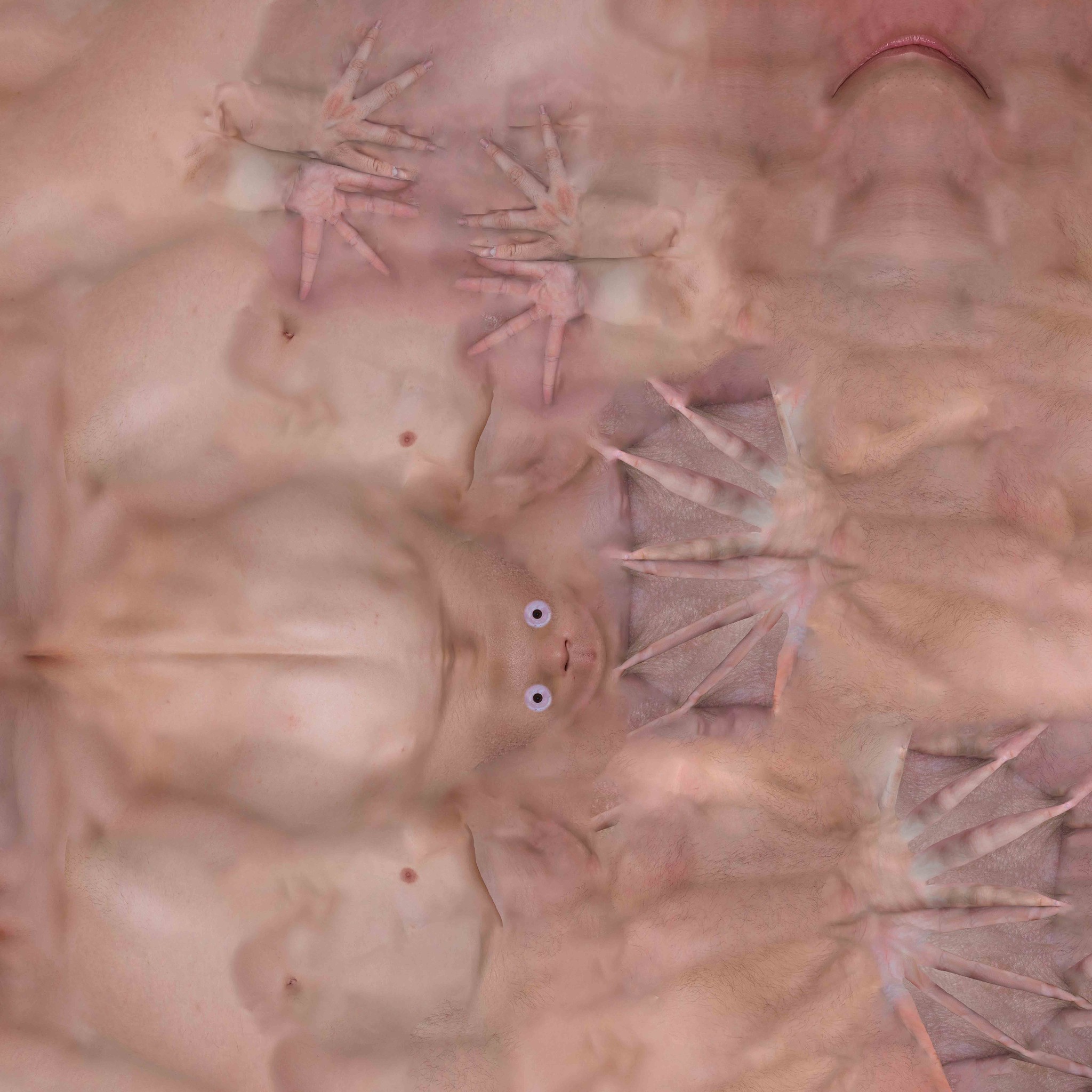
Inspired by the body without organs, images of my body parts are radically disassembled, cropped, rotated and duplicated to reterritorialise on the surfacing of another animal. My fingers mimic the shape and position of the insect’s eyes but do not serve the same function. At the same time, many people remark that my monochrome artworks appear like X-Rays of internal organs, even though these images are entirely constructed from my externalities and do not perform as bone. My artworks are, crudely speaking, fictions that masquerade under the artifice of what Biology agrees upon as fact. The resulting tensions prod us to reconsider the relationship between bodies, images, and knowledge. The body has a propensity for transforming out of what we deem as fact now, and these facts are also produced in contingencies to our spatial-temporal condition. I think to more broadly answer on the human vs the non-human, as a means to develop upon the organism vs fiction: there will always be the question of whether what we deem as “organisms” are also imaginations borne out of our anthropocentric and political desires to perceive and distinguish.
Endurance and the Queer Body
CNTRFLD. Your durational performances—such as The Myth of Sissypuss, Medusan Pink, and Soyfed Beef – 640 grams—place the body under visible strain. How do you think about endurance, control, and spectacle in relation to queer visibility within these works?
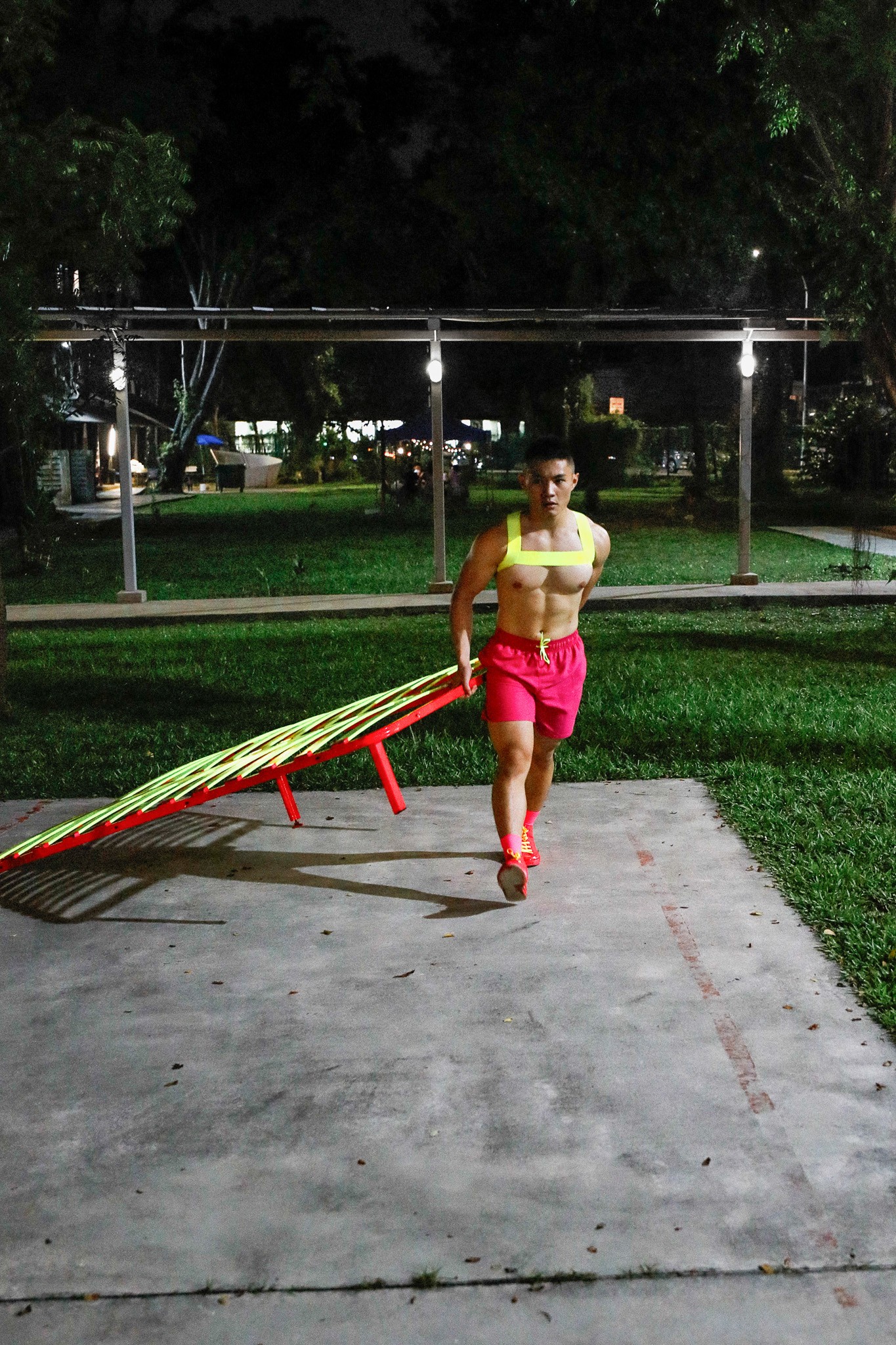
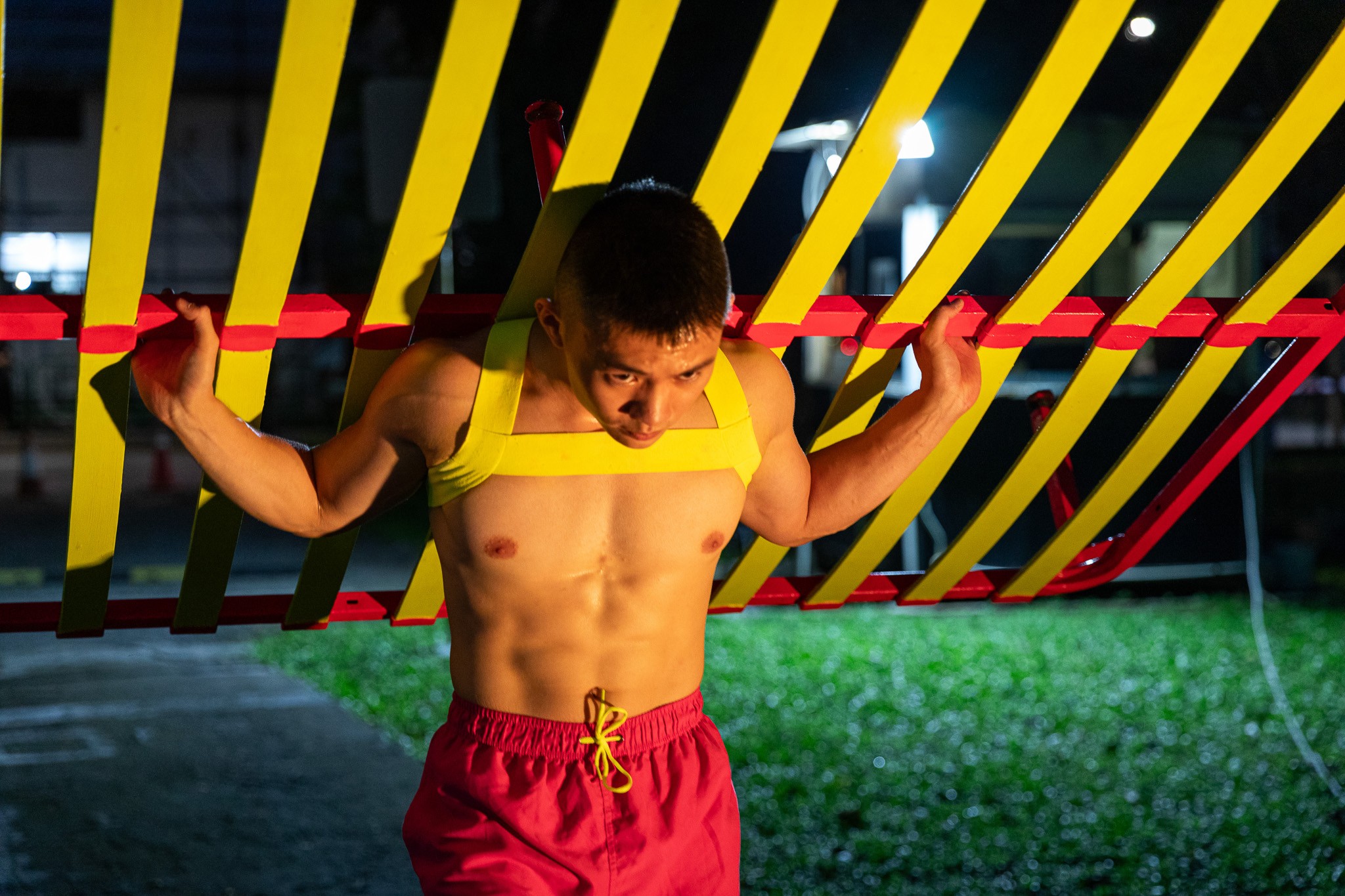
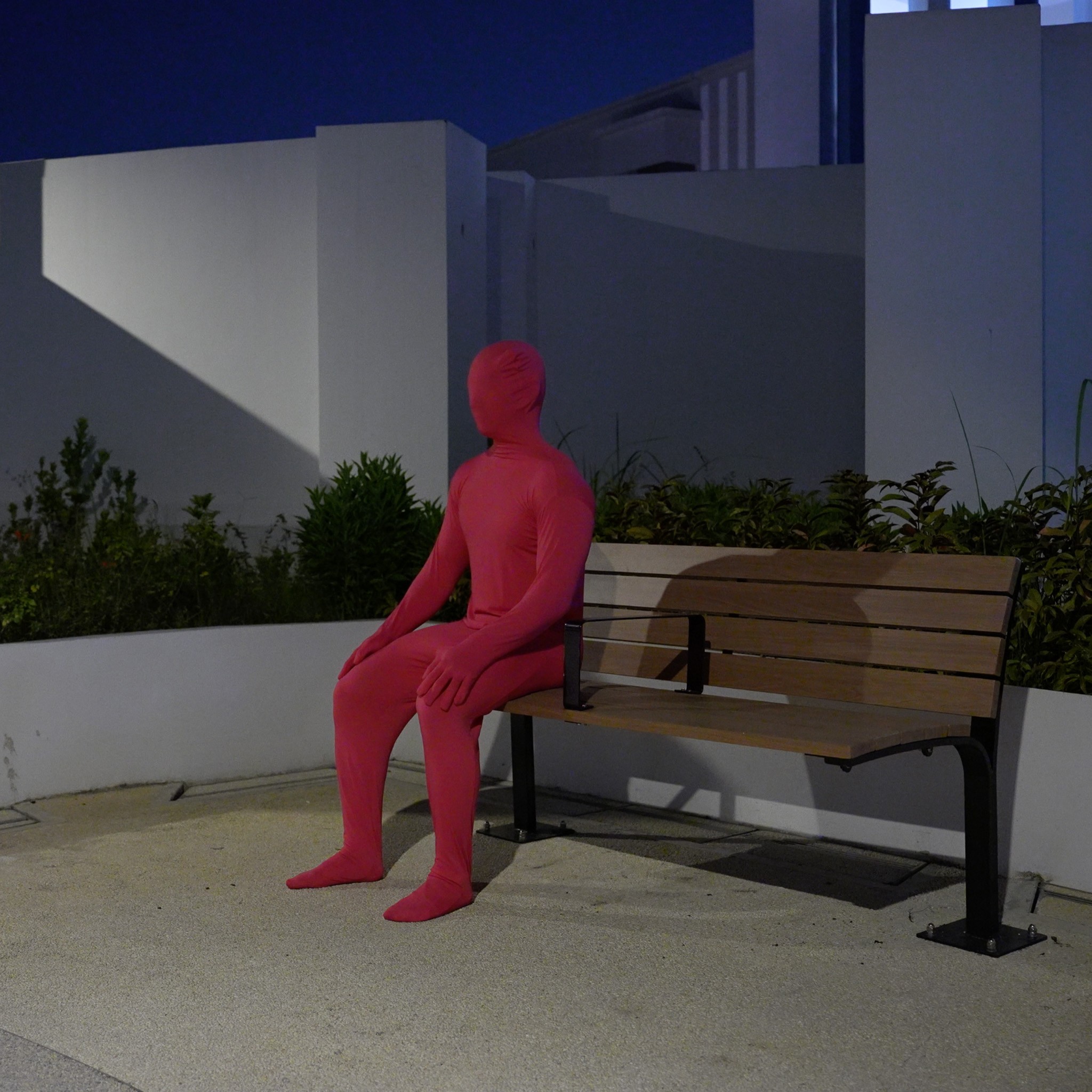
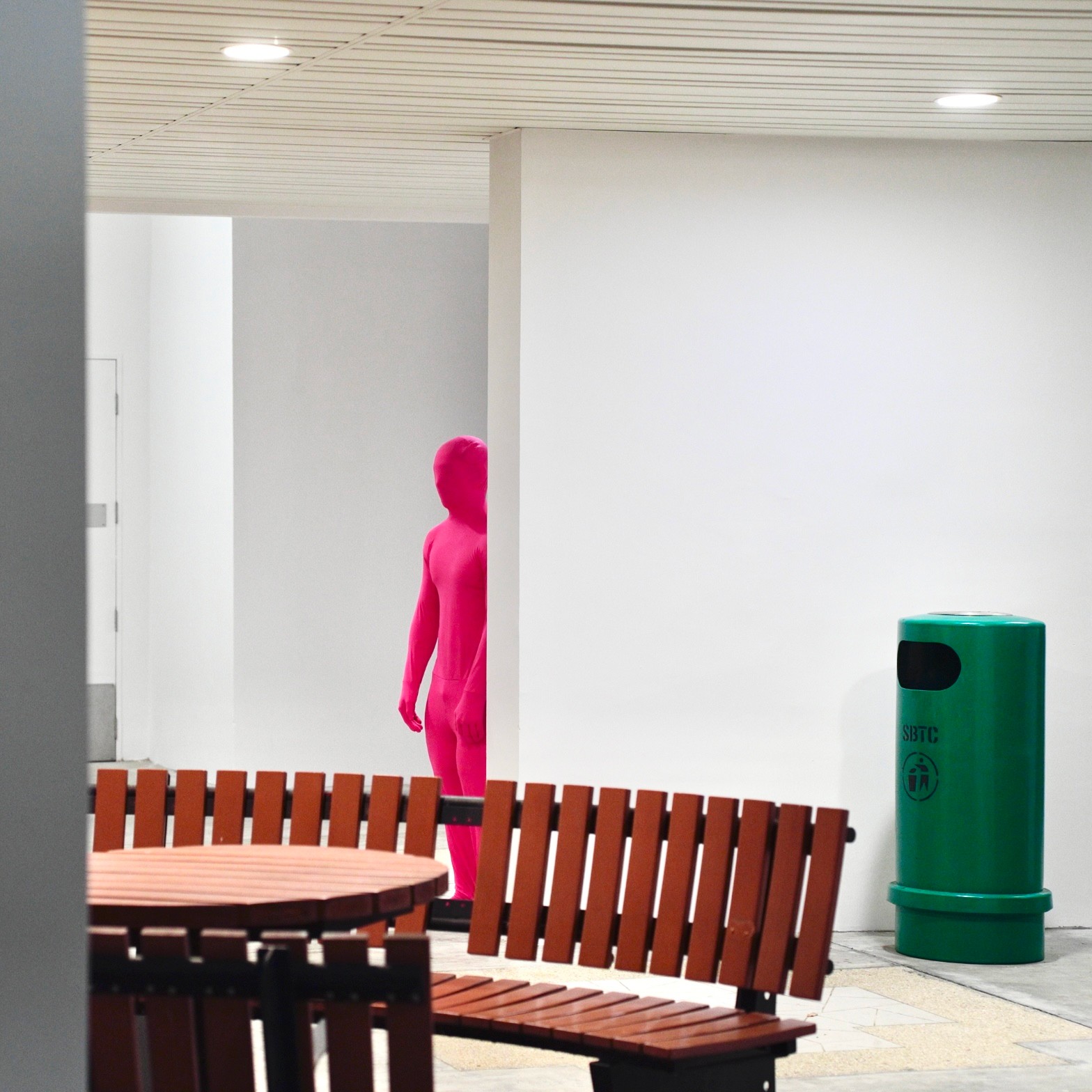
SGH. My durational performances tend to be physically demanding. In The Myth of Sissypuss, I carry a queen-sized bed frame over my head for almost two hours, while in the Medusan Pink series, I stand as motionless as possible for an hour at a time. In both works, the performance “costumes” are signifiers of queerness. The queen-sized bed frame is painted neon pink and yellow, while I appear shirtless in a bulldog harness—a visual language often associated with gay circuit party culture. What interests me is the relationship between queer labour and visibility. Both performances place the body under visible duress, asking it to endure weight, discomfort, exhaustion, or stillness. The labour is therefore not hidden but spectacularised. In this sense, the works reflect on how queer subjects are often compelled to exert additional labour in order to navigate, accommodate, or become legible within systems structured around heteroproductive expectations. In devising the performances, I reflect a lot on the way my mind operated when I was a child and not yet “out” to my family: “I need to be 乖 (guāi; obedient), a good filial son, get good grades, not overspend; so if my parents ever find out I am gay, at least I had been a good son”. The body is visible and represented in space, operating in the language of the normative and therefore paying the price.
To be reduced to spectacle is important here. While I have touched on it in previous questions, it is worth returning to because hypervisibility is often treated as a form of currency, particularly stemming from Western influence where visibility is equated with representation and evidence of social progress. My work proposes a different way of understanding these economies of visibility. To be placed under a spotlight is not simply to be seen; it is also to be fixed in place and subjected to the normative gaze.
As I walk in circles carrying a bed frame through a courtyard, or stand motionless in the lobby of a building, I deliberately position my body within public view. Viewers often initially respond with fascination, focusing on the endurance required to maintain the performance. Over time, however, this fascination frequently gives way to boredom and disinterest. The audience leaves, while the performer continues to labour. This shift is revelatory to me. Visibility does not necessarily produce recognition, understanding, or care. Instead, it casts the body as a seasonal spectacle that floats in-and-out of public consciousness (say, June every year). In this sense, the performances explore the costs of hypervisibility and the forms of exhaustion it produces. Standing in stark contrast to my performance works are my image-based pieces that evoke Asian and Middle Eastern thought: rights to opacity and illegibility that serve as alternatives to the ocular centric politics through which queer rights are often articulated.
Transformation
CNTRFLD. Your crab-based works feel distinct within your wider practice, often moving furthest away from recognisably human form. Do you see the crab as a site of release, transformation, defence—or something that resists resolution altogether?
SGH. Though they do not feature in the body improper, crabs have been a significant part of my practice since the beginning. They are one of the most fertile sites through which I have explored many of the questions that continue to occupy me, extending into my personal autobiography, science, and culture. Some of the topics I explore in other animals were actually first initiated by my explorations of crabs: I loosely associate the autotomy (self-amputation) process crabs go through to the metamorphic process I depict in second birth and the dancing naiad series. My interest in non-mammalian creatures also stems from these early encounters with the crab, whose alien appearance seemed so far removed from familiar forms of human connection and empathy. Protected by a hard, spiky shell, the crab (and after, other arthropods) came to represent for me the kinds of defensive barriers that marginalised people often construct in response to normative social structures. Looking at crabs through the glass tanks of seafood restaurants when I was younger, I quickly realised that they were alive but not as living as us to matter; the same way queer people were people, but not as “people” to matter either. And this sentiment had led me down looking for other animals that may be seen this way as well, animals in the fish trade or slated for dissection.
Crabs possess a remarkable ability to move across different registers of meaning. Almost as if their dextrous claws are sprawling rhizomatic-ally, or as if they are scuttling across different surfaces and hiding in the smallest of gaps in rock. I don’t really think that the “crab” in my work can really resolve itself — whether it finds itself becoming a form of release or transformation, the very nature of “becoming” is that it does not “become”. People often cite the crab as the “blueprint” for all crustacean convergent evolution, and indeed, many non-crab crustaceans evolve into shapes resembling the crab (something I explore in the mimesis (Porcelain crab) series). But evolution is not a “become”, and there are plenty of “True” crabs that no longer look like what we imagine crabs should look like as well. Various crab species have evolved into other shapes and forms, the same way the crab in my practice has evolved into dragonflies, arowanas and frogs.
Community, Grounding, and Legacy
CNTRFLD. Your practice engages deeply with relationality and co-becoming. In your own life, what—or who—helps keep you grounded, especially at this early stage of your career?
SGH. Frankly, I am still figuring things out. But I guess my practice grounds me—and the people who support me through it, believe in me, and critique me.
Advice
CNTRFLD. For emerging artists navigating questions of identity, sustainability, and long-term practice, what has helped you stay committed to your work?
SGH. I think it is important to constantly ask yourself what kinds of stories, questions, or concerns you feel compelled to pursue. This is not simply about “telling your story”. Rather, it is about identifying what within your lived experience continues to trouble, fascinate, or move you so deeply that you would build an artistic practice around it. It is also about asking what conversations you feel are missing, and what you might contribute to them.
For me, a sustainable practice is built on that sense of conviction. When you genuinely believe in the questions your work is asking, and are able to connect with others through those questions, that conviction can drudge your practice forward in the darkest of times.