“I’ve lived in Glasgow for more than a decade now, but Singapore remains an important part of how I understand myself. I don't necessarily experience those places as two separate identities. There is a constant movement between them, geographically, emotionally, culturally and through memory.”—Alaya Ang
CNTRFLD. Your current exhibition, Afterlives: The Weaver, A Chorus, An Archipelago, at Reid Gallery brings together three artists to explore the afterlives of colonialism in Southeast Asia. What first drew you to this theme, and how did the exhibition take shape for you?
AA. I’ve been interested in this question of colonial afterlives for quite a while, particularly through maritime histories and the movement of people, materials and knowledge across Southeast Asia.
I initially began thinking through the concept of “black waters”, kālāpānī (in Hindu) or Ayer Hitam (in Malay) a term historically associated with sea crossings undertaken by convicts, sepoys, indentured labourers and migrants across imperial maritime routes. I was interested in the sea as a space through which histories of displacement, labour and empire were carried.
That inquiry developed through my own artistic practice. During my Talbot Rice Gallery residency, I was researching the maritime knowledge systems of weights and measures and thinking about rope as a material metaphor for empire and labour and the connections to the Samsui women (women who came to British Malaya and worked in construction industry) and wider histories of Southeast Asian migrant labour. That continued into The Fingers Pulling the Thread, where I worked with textiles and mud-dyeing techniques that reference Cantonese gambiered silk, while also thinking about journeys, rivers and iron ore mining in Scotland.
The work developed over a residency in Singapore in April 2025, I began looking at my family's stamp collections. Philately became another way for me to think about trade, migration and how states and empires represent themselves through these very small images, and what gets made visible or invisible through them. I came across stamps from British Malaya, including imagery of rubber plantation workers, and that led me to look more closely at plantation histories.
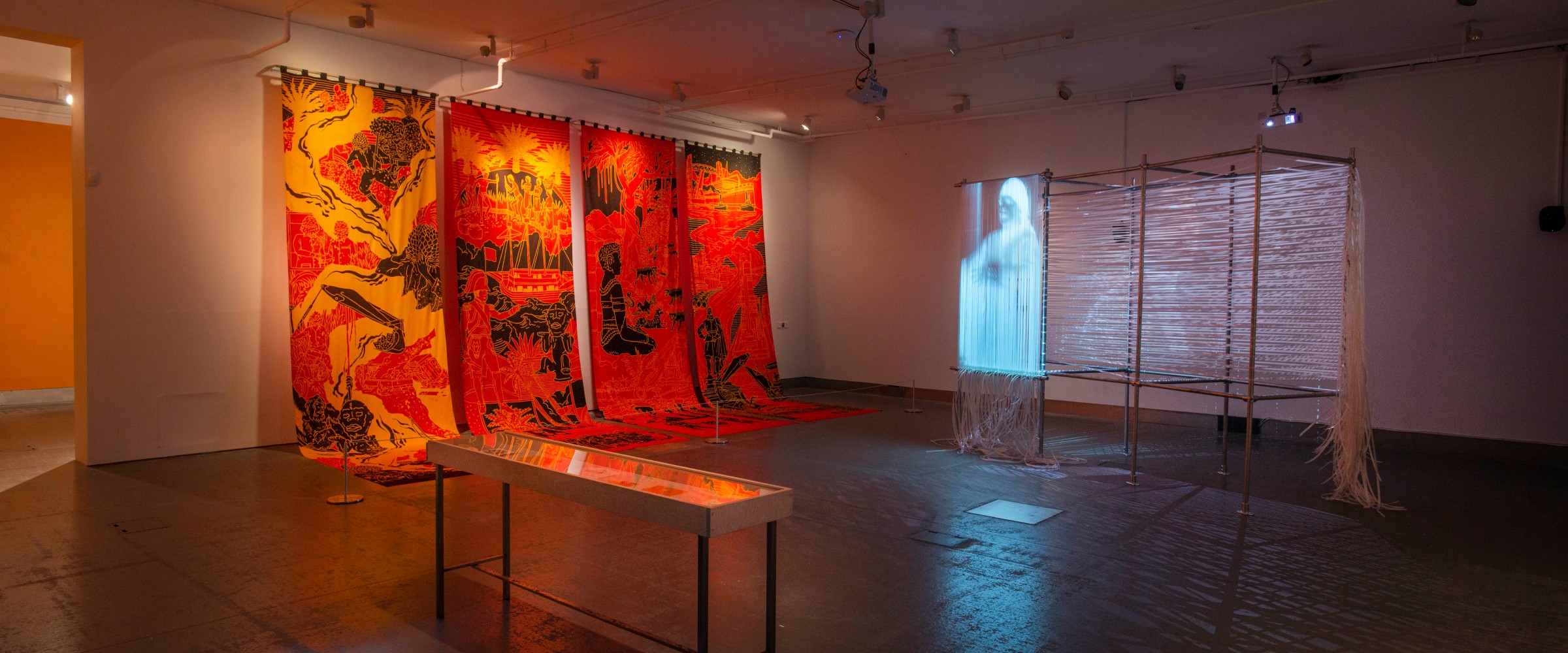
I went to Kuala Lumpur and visited Plantation Plot at Ilham Gallery, curated by Shean Yeun Lim, and encountered Gogularaajan Rajendran’s Coolies’ Chorus. I was immediately struck by the work because it approached plantation history through song, through memory, emotion and the body. And I knew I wanted to find a way to bring the work to the UK.
Around the same time, The Glasgow School of Art invited me to curate an exhibition in partnership with Glasgow Life in relation to Glasgow hosting the Commonwealth Games in 2026. That invitation gave me a context in which to bring some of this research together, and I began thinking about a curatorial framework for exploring colonial legacies in Southeast Asia, particularly the ways that histories of labour, migration and extraction continue to shape the present.
That was when the different strands of my research began to come together. I was interested in how Glasgow’s own history as the ‘second city of empire’ could be placed in conversation with Southeast Asian histories, and how the Commonwealth could be approached through the longer histories of empire that connect these places.
From there, the exhibition began to take shape around a question of how colonial histories continue to live in the present. When you travel through Malaysia today, for example, you may not encounter the rubber plantations that were so central to the colonial economy, but you see vast expanses of palm oil plantations. That shift in landscape made me think about how colonialism isn't simply something that belongs to the past. Its infrastructures continue to shape how we organise land, bodies and resources in the present.
I had also known of Bakudapan Food Study Group and that is what led me to Elia Nurvista’s practice and her work around palm oil, batik and extractive economies. I felt Elia’s practice offered a productive way of extending the conversation from the historical plantation economy into the present.
The idea of the archipelago in the title came out of this too. Southeast Asia is also referred to through the term Nusantara, this is an Old Javanese term understood as “islands between” or an archipelagic realm, stretching across the island and coastal regions of present-day Indonesia, Malaysia, Singapore, Brunei, the Philippines and southern Thailand.
I was interested in Southeast Asia as a network of interconnected islands, coastlines and movements, rather than as isolated national histories. But more importantly, I think of the archipelago as a way of holding difference and relation together, different histories and experiences that don’t need to collapse into one single narrative. Édouard Glissant offers us an understanding of the archipélique as a geography of relation, "the archipelago is a place where we can begin to understand and resolve the contradictions of the world." The archipelago becomes a way of thinking through complexity, creating the possibility for new peripheries to emerge.
So Afterlives became a way of bringing these different forms of remembering into relation: what has been recorded and what has been redacted. And it asks what responsibilities we inherit from these histories in the present.
CNTRFLD. The exhibition responds to the Glasgow 2026 Festival theme of ‘social justice’, but the works approach that idea through histories of labour, migration, memory and extraction. What does ‘social justice’ mean to you within the context of Southeast Asian histories and contemporary art?
AA. For me, the question of social justice while I was thinking about this exhibition is really a question of what happens after empire, what remains in people's lives, in landscapes, in systems of labour, and in the ways, histories are remembered or forgotten.
Also, the idea of social justice is also a question of amnesia. Who gets to forget, what gets forgotten, and what conditions make certain histories easier to forget than others. It is also important to me that social justice in art isn't simply about representing marginalised histories.
Also, the histories of Southeast Asia are incredibly complex, and they are often encountered in the Western narrative through quite simplified narratives of colonialism, independence, development, migration. But there are much longer and more complicated histories of movement, trade, labour, extraction, resistance and cultural exchange. Colonialism also doesn't simply end when a country becomes independent. Its infrastructures and systems can continue to shape economies, landscapes, labour and the movement of people.
So, for me, social justice is partly about resisting that historical amnesia. It means asking whose histories have been made visible, whose have been obscured, and what kinds of knowledge have been allowed to become part of the historical record, and which are memorialised.
Besides that, there are also long histories of grassroots organising, collective knowledge production and shared resources in Southeast Asia often developing outside conventional gallery and museum systems, that then become invited into arts and cultural spaces. The work of Ruangrupa and the idea of Lumbung, for example, has been important to conversations around collective practice and curatorial imagination. So, the question is also how we make space within curatorial frameworks for these different ways of working and does it reorder our existing institutional models.
So contemporary art can be a way of navigating these complexities, and resisting the idea that things need to be simplified, resolved or fixed.
CNTRFLD. The three artists — Erika Tan, Gogularaajan Rajendran and Elia Nurvista — work across film, textiles, performance and installation, and each approaches inherited histories differently. What conversations or connections between their practices became particularly important to you as the exhibition developed?
AA. What became particularly important to me was how each of the artists is revisiting obscured or marginalised histories through embodied and material practices. I was interested in what happens when histories that have been partially erased or reduced to fragments are approached through the body, through voice, through materials, and through personal and familial memory.
I kept coming back to the idea that every telling of history is also a kind of selection. When we construct a story, some things inevitably become foregrounded and other things disappear. So, I became interested in the artists not simply as recovering lost histories, but in how they were working with what remains, using fragments, traces, and memories and what might be possible to do with them.
Ocean Vuong in On Earth We are Briefly Gorgeous says “Who will be lost in the story we tell ourselves? Who will be lost in ourselves? A story, after all, is a kind of swallowing. To open a mouth, in speech, is to leave only the bones, which remain untold.”
To tell a version of events means consuming, digesting, and inevitably erasing some parts of it. Also, I thought a lot about return, led by Dionne Brand’s A Map to the Door of No Return.
For me, Gogu’s Coolies’ Chorus really reflected a kind of return that is happening through the work. It is a return that has taken generations. He takes a songbook of Malaysian Tamil folk songs, collected from plantations in Malaya, and travels back to Tamil Nadu, where he works with folk singers to reimagine the melodies and forms of the songs. The songs had been documented as lyrics, but the music itself had been lost. So, the work isn't trying to recover some supposedly authentic or original version. It is a process of reimagining through the voices and bodies of the folk singers.
And what I find important is that the songs allow another kind of history to emerge. They don't only speak about labour or exploitation within the plantation. There are lullabies, love songs, wedding songs, laments and festive songs. They allow us to imagine the lives of plantation workers outside the narrow category of the ‘coolie’, to allow us to think about their relationships, emotions, desires and everyday lives. The plantation becomes the context from which these lives emerge, but it doesn't define the entirety of those lives.
And this for me feels like an important archaeological work the artists are doing, not an archaeology of excavating objects but of looking for traces of lives within what has survived and finding ways to animate those traces again through an artistic practice.
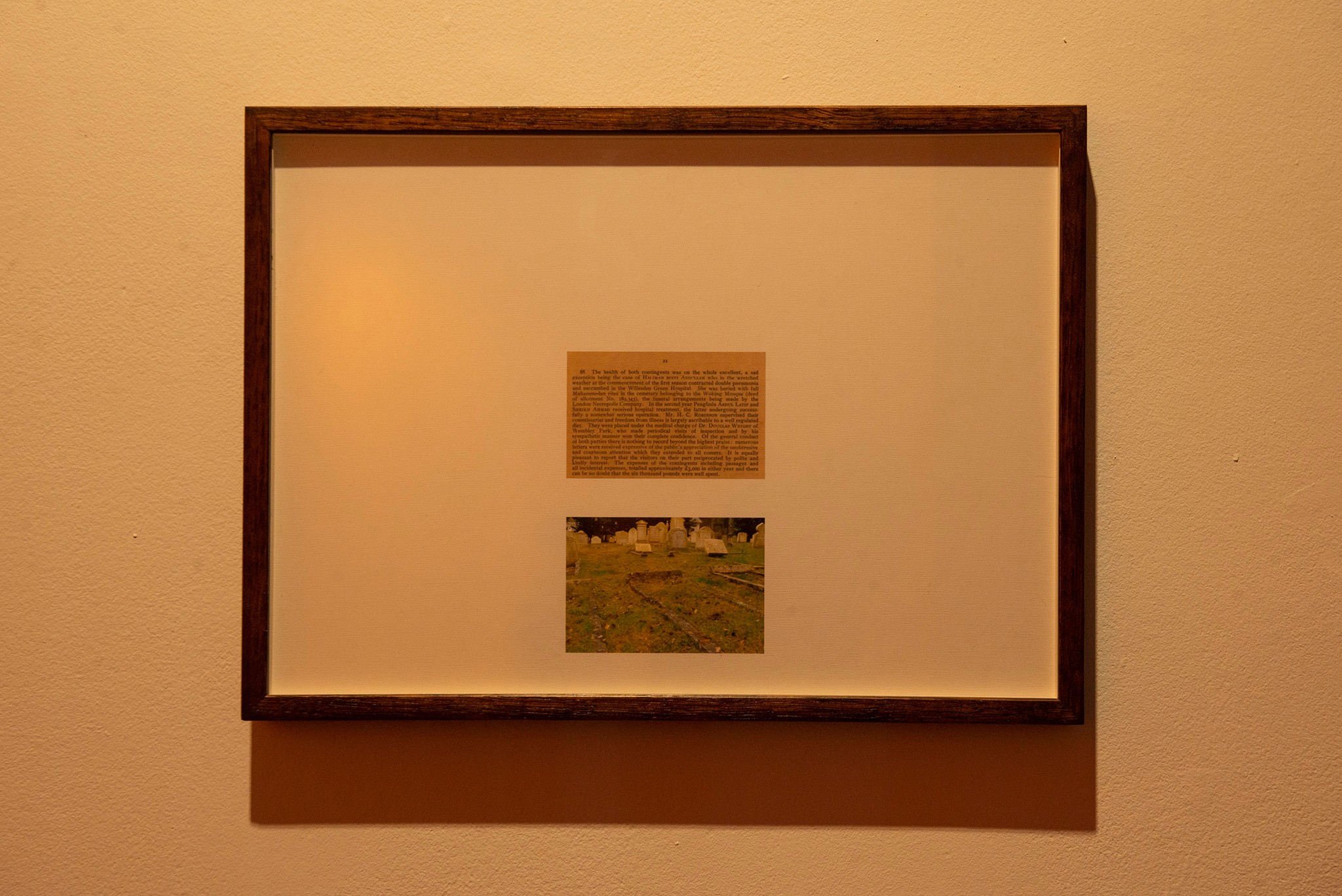
With Erika Tan’s The ‘Forgotten’ Weaver, that process begins with an almost impossibly small fragment: a footnote in the archive referring to Halimah Binte Abdullah. Halimah was a Malay weaver who travelled from Malaya to London in 1924 to demonstrate her craft at the British Empire Exhibition, and died soon after arriving, eventually being buried in an unmarked grave.
What is so powerful to me is that Erika doesn't try to turn that footnote into a complete biography. Instead, she stays with the incompleteness of the archive. Through multiple voices and an imagined, disembodied voice of Halimah, she creates a kind of spectral return, while also making visible the difficulties and biases involved in trying to reclaim a fragmented history.
That brought me to this idea of the minor figure, or the footnote. In histories, there are always things that don't appear, or people who appear only at the margins. And sometimes that marginal position tells us something about the structures that produced the history in the first place. Halimah's absence isn't simply an empty space waiting to be filled. The fact that she survives only as a fragment is itself part of the history.
And in Elia’s The Route, there is a different kind of return, she literally returns palm oil to the material of the batik process, making visible a commodity that we normally encounter only after it has been processed and absorbed into global supply chains. By using palm oil wax in the making of the work, the piece reconnects us to the labour, landscapes and histories that are often concealed once it becomes a commodity.
At the same time, my mum’s family after I completed the piece, The Fingers Pulling the Thread, also decided to embark on finding their ancestral home in Guangdong province, in Southern China. And so, this experience of return becomes carried across the exhibition.
There is a desire in all three works to return to something, a person, a song, a landscape, a material, a history but none of the artists suggests that we can simply go backwards and retrieve an untouched past.
What really came out from the conversations with the artists were the personal connections they bring to these histories. Gogu's engagement with plantation histories is connected to his own family history working on the rubber plantations and the Malaysian Tamil community. Erika's work around Halimah has also developed through a longer, personal engagement also with her mum’s artworks, archive and insertion into Singapore’s art canon. And Elia's research into extractive landscapes also intersects with her own family history in Kalimantan and her family's movement in relation to the development of those landscapes.
So, the personal becomes another way of complicating the archive. Family memory doesn't necessarily give us a more complete or ‘true’ history either, but it gives us another set of traces, another way of understanding how large historical structures are lived and inherited.
CNTRFLD. Your curatorial practice is rooted in Southeast Asian histories, community-led working and questions around home, migration and ancestral improvisation. How have your own upbringing and early experiences shaped the way you think about art, history and your role as a curator today?
AA. My interest in the ancestral comes from both personal experience and my research, but I think it first began with the ways I encountered ritual, and stories of hantu (ghosts), spirits, and shapeshifters like Madame White Snake. Coming from Singapore and Malaysia, I grew up with an understanding that the ancestral and the spiritual were not necessarily separate from everyday life. I remember my mum bringing me to Cantonese and Teochew operas that were often performed by the roadside. The first row of seats would be left empty for the ghosts, spirits and ancestors. There is something very striking to me about that gesture, including leaving food and drinks out for them, making physical space for those who are not visibly present, and acknowledging that they are still part of the community and part of the event.
The seventh-month ghost festivals were another part of this, burning paper replicas of objects for the dead. These practices shaped my understanding of ancestry less as something fixed or contained in the past, and more as something that is continually maintained and improvised in the present, like if your ancestor needed a new iPhone…you burn them a paper replica, received in the after world.
I think that has stayed with me also in how I approach art and history. I am interested in what happens when we take seriously forms of knowledge that might not always be recognised within official or institutional histories such as ritual, song, embodied memory, objects, offerings, family stories, and relationships with ancestors or spirit-beings.
My research has led me to think about these practices as practical and living forms of knowledge. They can be ways of navigating displacement, precarity and the legacies of colonialism, but also ways of creating belonging, care and continuity. This feels particularly important when thinking about diasporic communities, where ancestry isn't necessarily something that can simply be inherited intact. It is something that people continually reconstruct, adapt and make meaningful across different places and generations.
That is also where my interest in what I call ancestral improvisation comes from. I think about how knowledge persists through the body such as through repetition, ritual, song, gesture and sensory memory and how these forms of transmission can be activated through collective artistic practice. For me, this opens a different way of thinking about history: not only through documents and official archives, but through the things people continue to do, remember, perform and carry.
It has also shaped how I understand my role as a curator. I'm interested in creating the conditions for different kinds of knowledge and memory to meet, and in working with artists and communities to ask what has been remembered, what has been obscured, and what might still be carried forward.
I think my upbringing has therefore made me attentive to the presence of things that are not always immediately visible whether ghosts, ancestors, absences, fragments and inherited memories. That sensitivity has become central to how I think about art and curating: as a space where other forms of knowledge can be made present, without necessarily having to translate them into a single, fixed thing
CNTRFLD. You grew up in Singapore and are now based in Glasgow. How has moving between different places shaped your understanding of identity and belonging, and does your own experience of movement or diaspora influence the way you approach artists and histories in your work?
AA. I think moving from Singapore to Glasgow has made me understand home less as a fixed place that you either belong to or don't belong to, and more as something that you continually make. I've lived in Glasgow for more than a decade now, but Singapore remains an important part of how I understand myself. I don't necessarily experience those places as two separate identities. There is a constant movement between them, geographically, emotionally, culturally and through memory.
This experience has made me very interested in the idea of homing as an improvised act, meaning the ongoing practices through which people create a sense of belonging when they may not have stable access to a particular place. Home can be improvised through relationships, rituals, food, songs, objects, artmaking, and the communities we build around ourselves.
This also makes me attentive to the kinds of processes when I work with artists and histories, and in my own work with migrant and refugee communities. I'm less interested in asking whether something is an authentic representation of a particular place or culture, and more interested in what people are doing with what they have inherited. Also understanding diaspora and migration as a relational condition shaped by histories of colonialism, labour, and global capitalism rather than about fixed origins or destinations.
For me, that's where the idea of ancestral improvisation comes in. Sometimes you don't inherit something intact or there is a generational break and unspoken legacies. You inherit fragments, gestures, stories, objects, songs, in dreams and you have to make something with them in the present. That doesn't make the resulting practice less meaningful or less connected. In some ways, the improvisation itself becomes a form of inheritance.
So, I my own movement between Singapore and Glasgow has made me understand belonging as something always relational, ongoing and improvised. And I'm interested in artists and communities who are actively reworking forms of belonging and communities in the present.