“Even though my Cantonese isn’t great, we ended up being able to dance the waltz together. It proved that we didn’t need to speak perfectly to connect through movement.”— Donald Shek
SEEING ASIA FROM THE UK
VC. I moved here five years ago from Hong Kong, and when I was in Hong Kong, I always felt that I couldn’t quite fit in. Now, having lived here for five years and working in the art industry as a journalist covering arts and culture, I find that being here allows me to see a much bigger picture.
That’s something I never really had a chance to explore when I was in Hong Kong. I felt that I was always looking through a particular lens, focusing on a particular place and a particular lineage.
But being here, I feel that my world has expanded. I’m looking at a much broader region of Asia, and my world has become bigger.
PD. It does feel that the one thing that — although it has changed a little bit — the general climate in this country is that it’s quite welcoming, and it encourages expression, at least in the creative fields.
Obviously, we’ve seen slightly darker elements introduced over the last ten years, but generally, I think for artists coming into this country there is a sense that you can express yourself in ways you may not be able to in your home country.
Would you say that was indicative of how you’ve built your work? Do you feel that your work has had an opportunity to grow?
VC. Definitely. At least I’m learning something new about different parts of Asia here in the UK.
For example, I’ve met a lot of new friends from East and Southeast Asia as well as South Asia. Even though there is quite a prominent South Asian population in Hong Kong and we have close ties with parts of Southeast Asia, I never really had a chance to get to know those communities.
Being here, I think because of the way the art world functions, it allows me to make new friends and reach out to new communities. When we have conversations, we discover a lot of shared lived experiences and common interests.
DS. I’ve started hanging out a lot with the Vietnamese artists, and I feel that there’s a lot more collaboration happening in terms of growing together.
PD. I think because the creative population is larger in the metropolitan centres, there are more opportunities for cross-cultural conversations to take place, and that’s always inspiring.
Especially when you encounter something you weren’t expecting or anticipating, and it suddenly snaps into place or develops very quickly. That’s always an inspiring opportunity.
DS. It’s weird, though, because one of the people involved, Tuyet Van Huynh, is an artist/producer who is a pillar within the ESEA arts community. We used to go clubbing at the same places 20 years ago, but I’d never met her.
We know the same people. I thought, “I would have recognised you because you’ve got those tattoos on your arms!” But somehow, 20 years ago, I must have completely passed her by..
It’s quite interesting that we’ve now come full circle and met again as we’re older and can work together. We had mutual friends but strangely never crossed paths.
DIASPORA AS CONNECTION
VC. Recently, at SLQS Gallery’s exhibition No Place Like HomeNo Place Like Home III, focusing on artists of Vietnamese diasporic heritage, I took part in the conversation and wrote an essay reflecting on the show.
I learned that we actually have something in common culturally. I also discovered that some artists of Vietnamese background may also have Cantonese heritage. If I had stayed in Hong Kong, I might not have been able to discover all these new things.
DS. Some of the curators here have now moved over to Hong Kong, and there have also been shifts in the other direction. It would be interesting to see how that develops. So, I want to see what’s happening, because in a sense, the curators who are there now represent a very specific group.
PD. When you say a specific group, do you mean an economic or social stratum?
DS. No, I’d say just a different group — different routes of entry, different perspectives.
PD. Understood.
VC. I think the recent migration trend has really influenced the cultural industry, at least the art industry that I’m familiar with here.
There are curators who have moved to Asia, and also people from Asia who have moved here. Very recently, quite a few curators from Hong Kong have started working in different institutions.
I feel that these art professionals are bringing real changes and new perspectives to institutions here.
We’re seeing more Asian artists represented at major institutions, such as the V&A, Tate, and Hayward Gallery. It’s a great addition to the dynamic of this city, and I’m looking forward to some of the new changes that are coming.
AUGMENTED CHINATOWN AND THE ARCHIVE OF EVERYDAY LIFE
VC. A question for you, Donald: is one of the videos being shown here yours?
DS. Yes. It’s Augmented Chinatown 2.0.
Before Augmented Chinatown 2.0, the first project I entered was through an open call from Kakilang, formerly Chinese Arts Space, an organisation representing East and Southeast Asian communities, back in 2019.
What you see here is an expansion of that project. Unfortunately, it was delayed because of COVID.
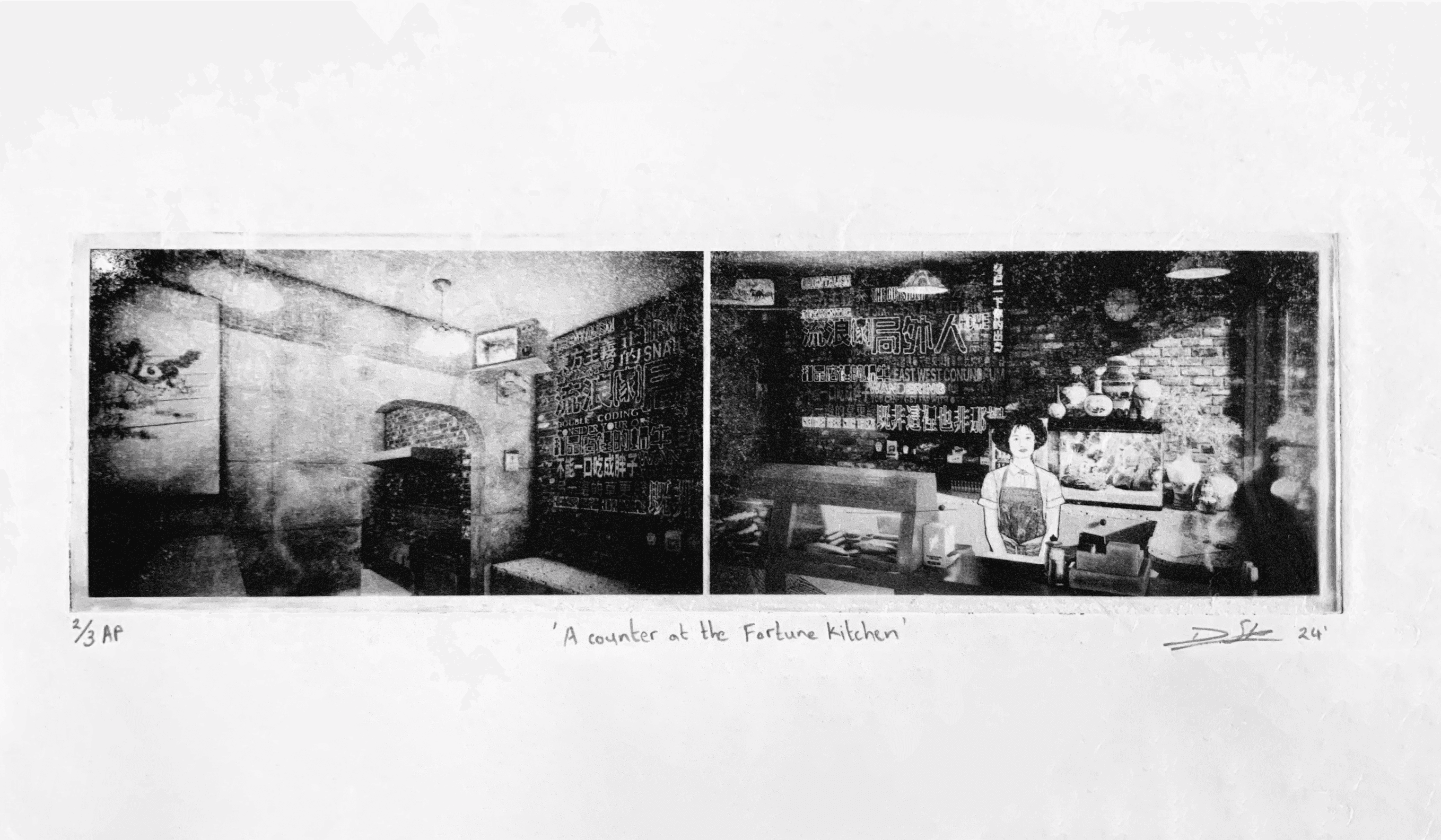
My background is in architecture and printmaking. Augmented Chinatown proposed a walking tour to understand the community and local history, looking into Eastern and Western mythologies. That was my first entry into the art world, and I’ve been continuing from there.
It was only in the last three years that I gave up architecture to do this full-time.
But without certain small groups of people, I wouldn’t have had the opportunity.
I mean, I still have no money!
VC. When you look at where we are living now, how do you see new developments or new ways of approaching East and Southeast Asian cultural heritage within the community?
DS. I think it’s still quite divided.
There are different parts of my family. Some family members are very much interested in the arts, and I can invite them to exhibitions and events. But other parts of my family can’t engage in the same way because there’s a disconnect.
I made a piece of theatre — Home X, an immersive digital theatre project conceived with An-Ting Chang and Ian Gallagher — and we toured around the UK, including presentations at York Theatre Royal, Cambridge Junction and the Barbican, and the work was subsequently nominated for the UK Theatre Awards Digital Innovation Award.
A few years ago, during a self-initiated research project into the diaspora I found some photographs in an old archive focused on my family — I found photos of my auntie’s salon and my uncle working in the local supermarket. Those businesses have all changed or closed now. The last business in Liverpool closed recently; that was my auntie’s shop.
So, it’s kind of gone.
But if you look at artists from earlier generations, there was a feeling of, “Can we stop drawing Chinese chip shops? No more dragons!”
PD. Yeah, exactly!
DS. Unfortunately, I couldn’t quite cross that myself.
FAMILY, CREATIVITY AND GENERATIONAL CHANGE
PD. The concept of family and how that influences you feels like it’s never going to go away.
You want to think that every generation is going to see an improvement. Certainly, if it’s a first-generation family that has moved to this country, or to any Western location, they’re very much fixed in their ideas.
I don’t think that’s confined to Asian or any Oriental culture. Any traditional culture that moves to a new location wants to retain as much of its values as possible. It's about maintaining identity.
That becomes a defining character in how your parents enable you to access the creative arts.
They’ll encourage it if you play the piano, violin or do ballet. But if you want to write, or pursue anything that seems economically unsustainable, it becomes a challenge.
DS. It’s the worst!
PD. Part of my first degree involved an exchange programme in America, so I spent a semester at university in New York.
At that time, I was doing a lot of journalism, and because my writing was mainly about dance music culture, my parents thought, “This is obviously some sideline. He’s not going to take this seriously.”
Being in America gave me an opportunity to interview so many major artists whom nobody in America wanted to know about, but whom everyone in Europe was crazy for.
I left my chequebook with my parents and said, “The cheques are going to come to you, so pay them into the bank.”
When they saw how many commission cheques were coming in, they thought, “Okay, actually he’s quite serious about this, and he seems to be doing all right.”
That was the first time they began to think this was actually possible for their son — that he could make this work economically viable. And that reassured them.
DS. As long as the parents see that your plan is actually secure, then they’re happy!
I’m looking into dance music culture right now for my first project around rave culture, looking at intergenerational social spaces and dancing as a way to release and to connect at a human level.
My parents owned a takeaway, and they would go clubbing when we were younger— so it’s a way for me to cross intergenerational lines.
My Cantonese is absolutely rubbish, but recently I did a workshop with six women who spoke Cantonese and Vietnamese. Even though my Cantonese isn’t great, we ended up being able to dance the waltz together. It proved that we didn’t need to speak perfectly to connect through movement.
PD. That was the universal language — dance.
DS. Exactly!
ART, COMMERCE AND CULTURAL EXCHANGE
VC. I had a question for you, Paul. You also advise companies on culture?
PD. I’ve done some work for Mercedes-Benz, and I was involved with Carsten Höller Fondazione Prada when they had an installation in London around 2008.
Carsten opened The Double Club, which became a six-month nightclub, pop-up restaurant and bar. Carsten likes to have a playful approach to his artwork. If you’re not sliding down giant slides, you’re dancing to Congolese music and mingling amongst sapeurs!
That was fascinating because I hadn’t had much experience in the art world before that. It was quite an entry point for me, which came about because I had a background in dance music journalism and was helping with the PR strategy.
VC. How has your experience been working with these companies, and what are your observations on how things are changing when it comes to art and creative heritage?
Are companies becoming more inclusive, or are they increasingly wanting to engage with different communities in order to reach new markets and clients?
PD. I think China has opened up a lot, and the movement of Chinese artists globally has grown.
Whether Western countries want to accept it or not, you can’t avoid the fact that they are making inroads not just economically, but culturally as well, and companies have had to acknowledge that.
For instance, magazines that started in New York in the 1990s are now putting energy into establishing Chinese editions, such as V Magazine.
VC. Yes, and Cultured has a Chinese edition as well.
There are a lot of changes going on, and we’re looking forward to the future.
I want to thank everybody for joining us this evening, and thank you so much, Paul and Donald.
PD. Thank you.