CNTRFLD. There’s a strong sense of care in your practice—not just in the themes, but in how you work with others. How do you think about support systems in the arts, and what have you learned from working across different cities and communities?
EL. My practice is relational and all relationships need to be handled with care. Whether it’s a relationship with a community, a group of friends, a place, a landscape, an endangered eel, a body of water, or an archival story, it needs to be actively nurtured, or ‘loved’. Embedding love ethics into the process of making work is important to me. I’m referring here to bell hooks' definitions of love as an active, continuous verb rather than a passive emotion. In her seminal book, All About Love, bell hooks writes about true love requiring deliberate actions of care, commitment, trust, responsibility, respect and knowledge. The knowledge here is knowledge of others acquired through deep listening, being attentive, noticing.
Of course, you don’t always get it right! Applying love ethics as a framework for collaboration provides a really useful criteria for resolving conflicts and evaluating projects, thus continually improving practices of care.
In my experience the best support systems in the arts are mutual support systems between artists, who can also be seen as friendship groups or chosen families. These are the familial bonds that can foster nourishment, creative and critical exchange, and love. Art institutions can be tricky spaces to navigate, so having a trusted network of peers can offer safe spaces to share experiences and build agency. bell hooks proposes that compassion, care, and mutual respect should serve as the foundational values driving all personal, political, and societal structures - art institutions could fare better in terms of support systems if they placed love ethics at the heart of everything they do.
My practice and mutual support systems are currently split between two cities: London & Sheffield. Sheffield has been a good place to be making work around racial justice, especially since COVID, when many artists of colour united through initiatives such as the Centre for Equity and Inclusion, Migration Matters Festival, and archival justice movement, Dig Where You Stand. I developed Four Quadrants of the Sky 四大神獸 with Bloc Projects who, under the stewardship of Director, Sunshine Wong has been platforming ESEA artists and artwork since 2020. We also have a Yorkshire ESEA Creatives WhatsApp group which is a great mutual support network, and in true ESEA style, we convene over food now and again.
CNTRFLD. In Anguilla Anguilla, the endangered eel becomes both an ecological subject and a symbolic presence. You often return to water, migration, and multi-species narratives—what continues to draw you to these ideas?
EL. Anguilla Anguilla, way of the eel was a great opportunity to return to my research around the Thames Estuary. In 2016 I’d been intrigued by the disappearance of the European Eel from the river, especially after it had been so abundant, and such an important part of London’s affordable food culture. I was also fascinated with how after living in the Thames for 20 years, the European Eel has an urge to make the long journey back to its birth place in the Sargasso Sea, where it spawns and dies.
With these incredible life cycles, and ways of navigating the planet, I was curious about what we could learn from eels about notions of home, migration and entangled ecologies. One question that arose through the project was, does an eel think of itself as diaspora when it’s living in London, or are all the water bodies it lives in and travels through called home?
I think I’ll always be drawn back to intertidal zones, because as mentioned earlier, these liminal landscapes hold me, and have become part of my embodied mythology. Being both land and sea, water and mud, they cannot be defined in binary terms. Like queerness, mixedness, and migratory energy, this watery land is fluid and in constant flux. And like Bruce Lee’s philosophy of , ‘be water’, if we embrace those attributes we can find power in being prepared for change - a martial art where we are practising different ways of being together –rehearsing our futures into existence.
CNTRFLD. You’re currently developing Yellow Peril, your first narrative feature. What has moving into long-form filmmaking opened up for you—creatively or politically?
EL. Yellow Peril is the third iteration of the Monster Trilogy. Getting a narrative feature film made is hard! Politically, you are less likely to get one made in the UK as an ESEA filmmaker, telling ESEA stories, but I’m pushing on! Stories of the othering of strangers are always ‘timely’, but the times we’re living in now, where xenophobia on a local and global scale is running rife, makes me more determined to get it made. Of course, making long form work takes more time commitment than short form, and with artists' incomes being so precarious, it can be a challenge to maintain momentum when you’re not getting paid.
CNTRFLD. You’ve described 2026 as a year of development, with upcoming work including the Karachi Biennale in 2027 and a possible new iteration of Ancestral Futures during the Hungry Ghost Festival. How are you approaching this period—and what feels most important to nurture right now?
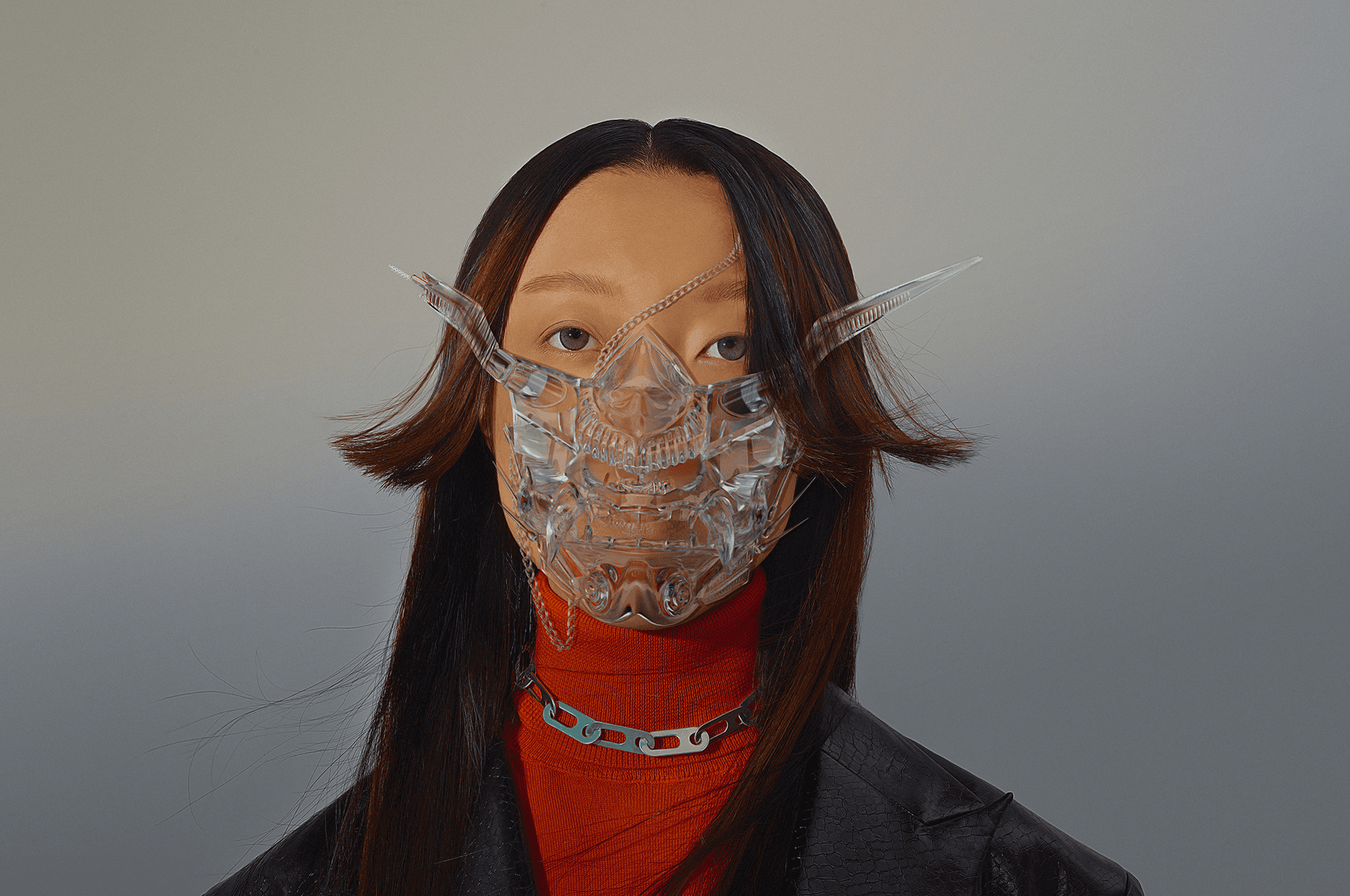
EL. Yes, Anguilla Anguilla, way of the eel will be shown at the Karachi Biennale in January 2027, and as part of the original film commission from Richmond Arts and Ideas Festival, I will be in attendance! And yes, I’m currently fundraising to make a bigger and louder iteration of Ancestral Futures 源流之後, an ESEA street procession that will see eight new mythological characters take to the UK streets next year. The first iteration was made in honour of the first recorded Chinese people in Sheffield - a group of magicians who performed in the city in 1855.
Presented in Sheffield in 2024 during Hungry Ghost Festival, and at the time of far right rioting, the procession was an act of defiance - of taking up public space and writing our bodies, our ancestors, and our futures into the city streets.
I’m also developing a couple of immersive projects. Conjuring Acts explores how the Chinese magicians who toured the West in the 1800’s captured the white imagination, resulting in early cases of yellowface. So this is an extension of the archival research I began for Ancestral Futures 源流之後.
Together with Yellow Peril, these are ambitious projects of scale, so I’m taking time to develop scripts, learn about the immersive and XR sectors, apply for funding, and build relationships with Producers. Of course, this doesn’t bring in any money, but mentoring young filmmakers, and doing the occasional presentation and panel event provides me with a basic income.
CNTRFLD. For artists working across identity, collaboration, and socially engaged practice—often without stable support—what has helped you sustain your work, and what would you pass on to others coming up now?
EL. In the 2000’s there was a lot more money available to fund this type of work. I have witnessed that funding disappear and have adapted to delivering projects for a lot less. Over the past 12-18 months I have seen that funding shrink even more, and funding opportunities become more competitive. In this climate, I would suggest collectivising and setting up an artist-led charity or CIC which will provide access to wider funding opportunities.
That said, it’s important to maintain the ethos of an artist-led collective - explore what that means and try not to not fall out! We need to learn how to be together in love - apply love ethics, build strategies for resolving difficulties, and navigating structural inequalities.
There are models out there - look to the architecture and design studios such as Resolve Collective, and beyond the UK such as Ruangrupa in Indonesia.
We need to organise and strategise our work, to create the right conditions for collectively imagining, rehearsing and manifesting the worlds we want to thrive in.