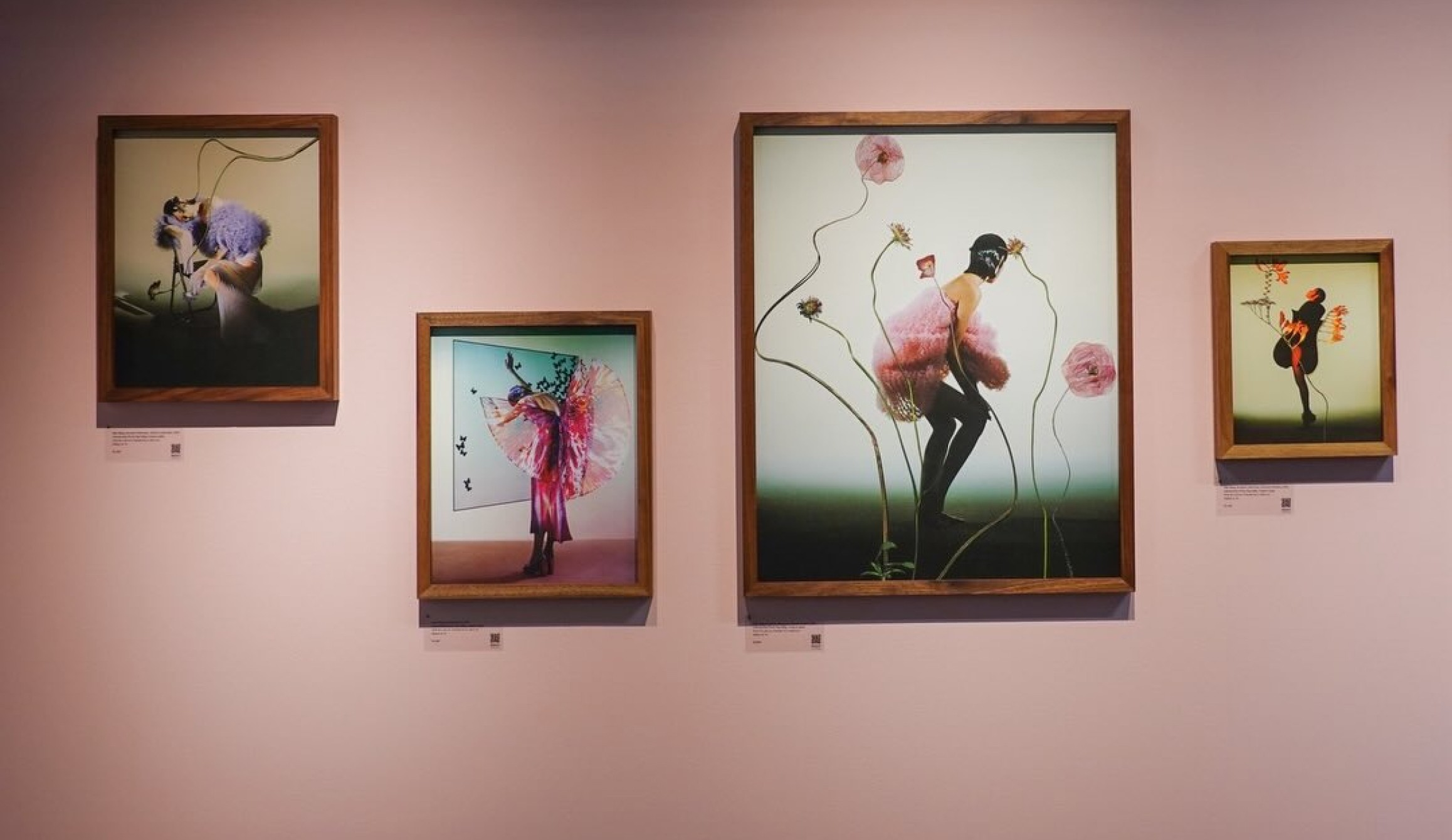
“We are constantly moving between different versions of ourselves, shaped by culture, gender, memory, desire and social expectations.”
— Han Yang
CNTRFLD. Your practice moves fluidly between editorial fashion photography and deeply personal artistic projects. Do these feel like two separate worlds to you, or are they part of the same creative conversation?
HY. In the past, I may have understood editorial fashion photography and personal artistic projects as two separate spaces. But at this stage of my practice, I am more interested in expanding the space between them and creating a new language within that intersection.
For me, they are part of the same creative conversation. While I am interested in pushing the boundaries of fashion photography, I am also using my own visual language to express more personal, psychological and cultural questions. They often overlap within visual culture and cultural production — sometimes through the body, sometimes through identity, styling, performance, or the atmosphere of an image.
Rather than seeing fashion and art as fixed categories, I see them as spaces that can inform, challenge and transform one another.
CNTRFLD. Many of your works explore psychology, vulnerability and transformation through highly symbolic imagery. What first drew you towards these themes, and what keeps you returning to them today?
HY. These themes are closely connected to my own identity, cultural background and lived experience. As a female photographer, I first began using photography as a way to ask who I was, what I wanted to make, and why I needed to make it. During this process, I was deeply influenced by psychoanalysis and feminist theory, including Sigmund Freud’s writings on gender and sexuality, Jacques Lacan’s mirror stage, and Simone de Beauvoir’s The Second Sex.
Later, through my MA and doctoral research, I continued to explore these questions through Donna Haraway’s cyborg feminism and Rosi Braidotti’s posthuman feminism. These theories gave me a foundation for thinking about the body, gender, identity and transformation beyond fixed categories.
At the same time, my work is also shaped by my own life experiences, my changing identity, and my movement between different cultural contexts. I return to vulnerability and transformation because I see identity as something constantly in motion. Symbolic imagery allows me to express these psychological and emotional states without making them too literal. Through the body, colour, gesture and atmosphere, I try to create images that hold what cannot always be easily spoke
CNTRFLD. Looking back, were there any experiences, places or influences from your childhood in China that still shape the way you see and make images today?
HY. Yes, very much. I grew up in China, and many of my earliest memories are connected to landscape, nature and visual culture. I was surrounded by photography from a young age because my parents were photographers, so cameras were very present in my everyday life. At the time, I did not imagine that photography would become my own path, but looking back, I think that early exposure quietly shaped the way I understand images.
My father also had a strong love for traditional Chinese bird and flower painting, as well as landscape painting. That influence stayed with me. In Chinese art and poetry, nature is rarely only decorative. It often carries emotion, philosophy, memory and personal aspiration. This has deeply shaped the way I use natural elements in my own work, such as flowers, birds, animals, light, water, and organic forms.
I am also influenced by ideas from Chinese philosophy, including the relationship between movement and stillness, softness and strength, human beings and nature. These ideas are not always literal in my images, but they exist in the atmosphere, composition and symbolic structure of the work. I think my childhood in China gave me a sensitivity to subtle emotion, restraint and metaphor. It taught me that an image does not need to explain everything directly. Sometimes what is hidden, quiet or suspended can be more powerful than what is fully shown.
CNTRFLD. Your work often feels suspended between realities—between dream and memory, the physical and the emotional. What interests you about these in-between spaces?
HY. I am interested in in-between spaces because I think many emotions do not exist in a fixed or clear form. They often appear between memory and reality, between what we can touch and what we can only feel, between the physical body and the inner psychological world. Many symbols in my work have specific meanings, and I often build them very consciously. They may come from Chinese culture, feminist theory, the body, animals, flowers, or ideas around transformation and identity. But when these symbols come together inside an image, they also create an atmosphere that cannot always be explained in a direct way. I think dreamlike or suspended spaces allow the viewer to enter the work emotionally before trying to understand it intellectually. They leave room for intuition, memory and personal association. For me, these spaces also reflect the way identity is formed. We are constantly moving between different versions of ourselves, shaped by culture, gender, memory, desire and social expectations. Photography allows me to hold those unstable moments, where something fragile or difficult to name becomes visible.
CNTRFLD. Having built your career between China and the UK, how has living and working across different cultural contexts influenced your understanding of identity, belonging and self-expression?
HY. Living and working between China and the UK has made me understand identity as something fluid rather than fixed. When I was in China, many parts of my identity were closely connected to family, culture, language and collective memory. After moving to the UK, I began to see myself from another distance. That distance allowed me to question where I come from, what I carry with me, and how I want to express myself as an artist.
It has also made me more aware of the complexity of belonging. I do not think belonging is always about feeling completely at home in one place. Sometimes it is about learning how to live with difference, displacement and change. This experience has deeply influenced my work, especially my interest in identity, the body, gender and transformation. Self-expression, for me, is not only about showing who I am. It is also a way of questioning the structures that define us, and imagining other ways of existing.