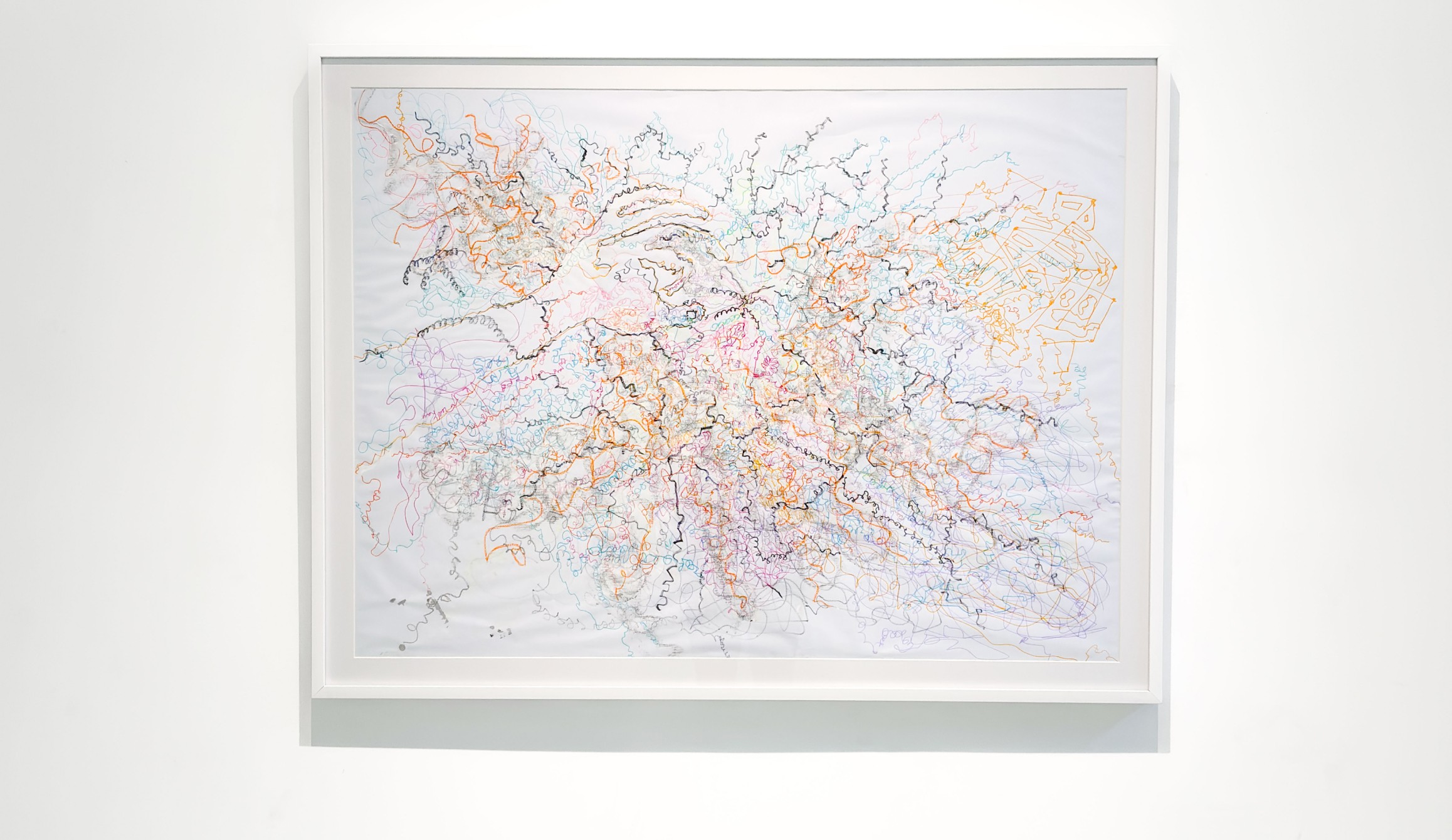
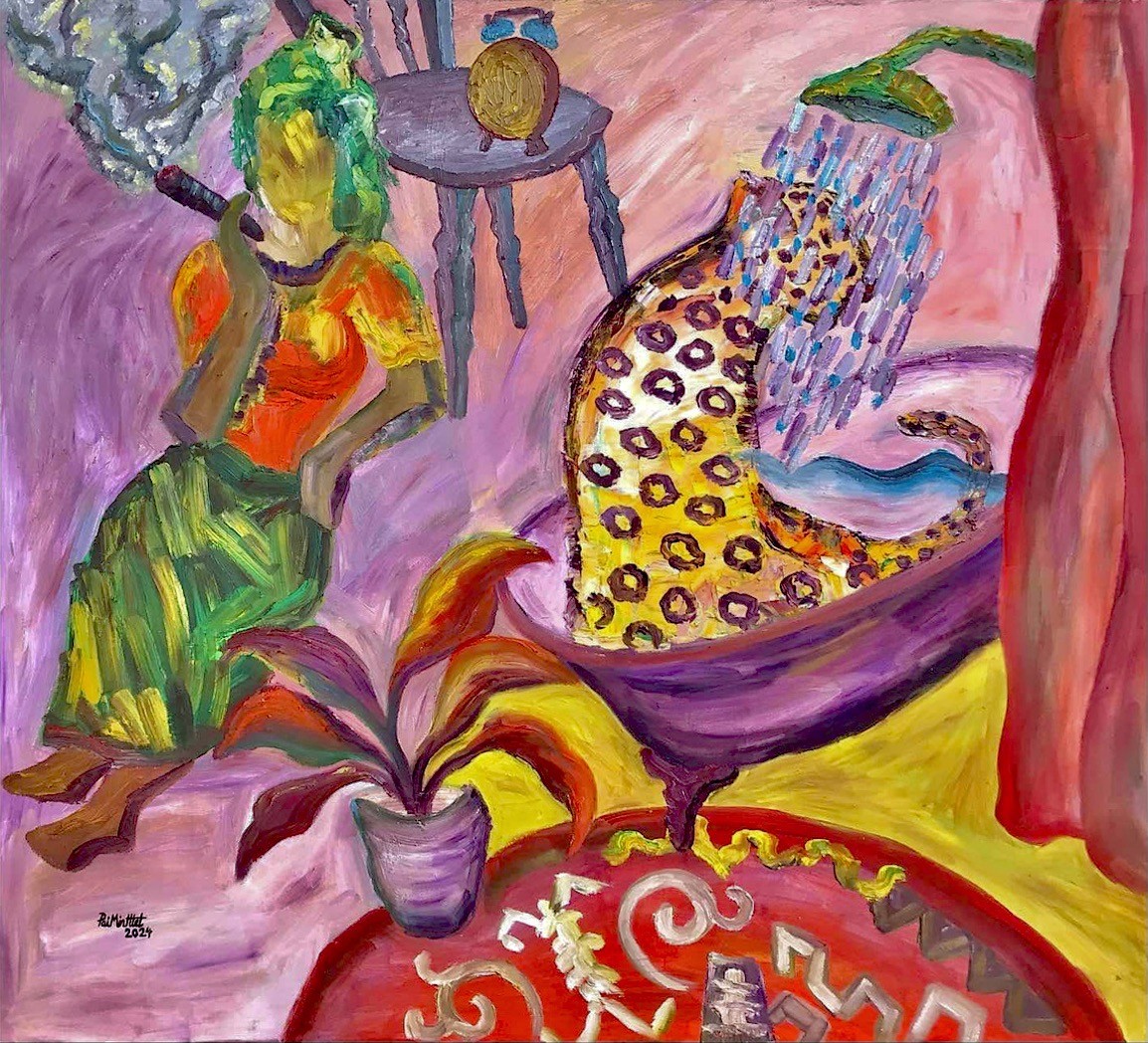
CNTRFLD. Aung Myint has long been recognised for pushing against convention, both artistically and culturally. What do you see as the defining qualities of his work, and why do they continue to resonate today?
MTK. For me, the defining qualities of Aung Myint's work are simplicity, fearlessness, and an almost unstoppable commitment to making art.
What I admire most is not a particular style or medium, but his attitude toward creation itself. Looking at his career, I often feel that if he can make art one way, he will. If he cannot, he will find another.
If he can hold a brush, he will paint. If he can no longer make a clean stroke, he will make a rough one. If a brush is no longer enough, he will pour paint. If he cannot even hold the paint bottle, he will dip his hands into the paint and leave palm prints on the canvas. The method changes, but the desire to create remains the same.
That spirit is what resonates with me. It is not about technique. It is not about perfection. It is about an artist who simply refuses to stop making art.
His work also taught me something important about simplicity. Many people assume powerful art must be complicated, but Aung Myint often demonstrates the opposite. Through simple colours, direct gestures, and seemingly uncomplicated forms, he creates works that leave space for emotion, memory, curiosity, and personal reflection.
When I think about artists like Mark Rothko, whose colour fields evoke profound emotional responses, or Henri Matisse, whose apparent simplicity conceals extraordinary sensitivity, I am reminded of a similar quality in Aung Myint's work. Simple colours can completely change the way we feel. A slight shift in colour, balance, or composition can create calmness, tension, nostalgia, warmth, or even uncertainty. His work reminds me that simplicity is never the absence of meaning. Sometimes it is the most direct way of reaching it.
CNTRFLD. Through Inya Gallery and his wider activities as an artist, mentor and cultural catalyst, Aung Myint helped shape an entire generation of contemporary artists in Myanmar. Looking back, what do you think his most significant contribution to the country's artistic landscape has been?
MTK. I think his greatest contribution extends beyond his own artworks. Through Inya Gallery and his mentorship, he helped create opportunities for artists to experiment, exchange ideas, and develop their practices.
Many artists from different generations have been influenced by his openness, generosity, and willingness to support others. His impact can be seen not only in the works he created, but also in the artistic community he helped nurture.
For many artists, Inya Gallery was more than an exhibition space. It was a place for conversations, learning, and exchange. I think that legacy continues to influence Myanmar's contemporary art scene today.
CNTRFLD. What do you think younger artists and curators can learn from Aung Myint's approach to making work and sustaining an artistic practice, particularly during periods of uncertainty and change?
MTK. Unfortunately, I did not have as many opportunities to work directly with Aung Myint as I would have liked, especially in recent years. Most of my interactions were through his family because of his health.
However, one thing that has always stayed with me is the way he sees art. His approach appears simple, but the more time you spend with it, the more you realise how much depth exists beneath that simplicity.
Through his work, I learned that powerful art does not always require complexity. A simple colour, a simple brushstroke, a simple shape, or a simple combination of forms can create questions, emotions, memories, curiosity, and reflection. Sometimes changing a viewer's perspective is enough to completely transform how people experience an artwork.
More than anything, he reminds me that art does not need to prove itself through complexity. It only needs to be honest.
I think that is one of the greatest lessons younger artists and curators can take from him. For artists, his life reminds us that making art is not about waiting for perfect conditions. It is about continuing to create with whatever you have. For curators, his practice reminds us that simplicity, honesty, and consistency often leave a deeper impact than constantly chasing something new. His career shows that staying true to your own artistic voice over time can be far more meaningful than following trends.
Regional Platforms & Impact
CNTRFLD. Over the past year, Supples has emerged as an important platform for Myanmar artists working beyond their homeland, from Unsettled Journeys to the recent Aung Myint exhibition. How do you see the gallery's role within this wider artistic community, and why do spaces like this feel particularly vital right now?
MTK. Over the past year, Supples has become an important platform for Myanmar artists, and I feel fortunate to have contributed to that journey through exhibitions such as Unsettled Journeys and Clash, Aung Myint’s solo show.
What I appreciate most is the gallery's willingness to support projects that introduce Myanmar artists to new audiences while encouraging conversations that go beyond commercial success. Of course, galleries play an important role in helping artists reach collectors and sustain their practice, but I believe their responsibility extends much further than sales.
For me, galleries should create meaningful experiences for audiences and meaningful opportunities for artists. I am particularly interested in working with underrepresented artists, especially from Southeast Asia and Myanmar. There are many talented artists whose work deserves wider visibility, and galleries can play an important role in connecting those artists with new audiences, collectors, and institutions.
I also believe galleries have a responsibility to take risks. Sometimes the most important exhibitions are not the most commercial ones, but the ones that introduce audiences to artists and ideas they may not otherwise encounter.
Spaces like Supples feel particularly important because they create room for regional exchange. When artists, curators, collectors, institutions, and audiences engage across borders, new perspectives and opportunities emerge. The more these conversations happen, the stronger our artistic community becomes.
CNTRFLD. Curating often involves building connections between artists, institutions, collectors and audiences. What do you enjoy most about acting as that connective tissue, and what have been some of the most rewarding moments you've witnessed through these collaborations?
MTK. What I enjoy most is bringing different people together around art. Every exhibition creates an opportunity for artists, collectors, institutions, galleries, and audiences to meet through a shared experience, and I find that incredibly rewarding.
One project that has stayed with me is A Living Legacy of Myanmar Impressionist: Dr. Lun Gywe at The Sea Art Gallery in Myanmar. It brought together a private collector, a gallery owner, and the artist's family to celebrate the lifetime achievements of one of Myanmar's most respected artists.
What I remember most was thinking about how audiences would experience the exhibition. Rather than simply presenting the paintings together, I organised the collection into four sections across four different rooms, allowing visitors to move through distinct bodies of work and experience different artistic approaches as they progressed through the exhibition.
Watching people slow down, spend time in each room, and experience those transitions reminded me that curating is not only about selecting artworks. It is also about shaping the journey people take through an exhibition.
For me, those moments are the most rewarding. A collector shares a lifetime of collecting. A family sees an artist's legacy celebrated. Visitors discover new ways of looking at familiar works. While exhibitions may only last for a short time, the experiences, conversations, and connections they create can stay with people for much longer.
CNTRFLD. You are currently based in Thailand. What keeps you there creatively and professionally, and how has living and working in Bangkok influenced the way you think about art, community and cultural exchange?
MTK. Thailand has become a place where I have been able to continue growing both creatively and professionally. It offers safety, educational opportunities, an active art scene, and the chance to build meaningful regional connections. Although Myanmar will always be home, Thailand has also come to feel like home in a different way.
Living here has broadened my perspective. I have been exposed to artists, curators, galleries, collectors, and institutions with different backgrounds and ways of thinking. That diversity has changed how I approach exhibitions and strengthened my belief that cultural exchange is essential for the future of our region.
Projects such as Her Valor, Her Vision, Her Voice, with The Sea Art Gallery, which brings together women artists from Myanmar and Thailand, reflect that belief. I enjoy creating opportunities for artists from different communities to learn from one another while introducing audiences to perspectives they may not otherwise encounter.
For me, Bangkok is not simply a place to live. It is a place where new conversations, collaborations, and friendships continue to shape my curatorial practice.
CNTRFLD. Looking ahead, are there any upcoming projects, artists or collaborations you're particularly excited about? What can audiences expect from the next chapter of your curatorial practice?
MTK. The next chapter of my practice is becoming much more diverse, and I am excited that three upcoming projects have already been confirmed.
One is the continuation of Her Valor, Her Vision, Her Voice. After its presentation at Chiang Mai University, the exhibition will travel to Bangkok with the support of The Sea Art Gallery. I am excited to see the project reach a new audience and continue the dialogue between women artists from Myanmar and Thailand.
Another project is a collaboration with Yangon in Action, the production behind the 45-minute film THE LAST ZAWGYI, inspired by one of Myanmar's best-known mythological characters, Zaw Gyi. Based on the released film, the exhibition expands its universe through animated shorts, large-scale digital art prints created by digital artists from Myanmar, character narratives, a comic book, and limited-edition collectible figures.
As the curator, my role is to bring these different elements together into a cohesive exhibition experience. What excites me most about the project is exploring how mythology, digital media, publishing, and collectible culture can come together within a contemporary exhibition.
I am also preparing an exhibition with Aye Ko, a longtime friend of Aung Myint, which will take place later this year at Supples. I look forward to introducing more audiences to his work while continuing conversations around contemporary Myanmar art.
Beyond these confirmed exhibitions, there are several more projects currently in development. Although each project is different, they all share one thing in common. I am interested in creating exhibitions that connect artists, audiences, and ideas while encouraging people to experience Myanmar art and culture from new perspectives.
CNTRFLD. When you think about the future of Myanmar art on the international stage, what gives you the greatest sense of optimism?
MTK. What gives me the greatest sense of optimism is the people. Many established Myanmar artists already have regional and international recognition, and I believe the next important step is creating more opportunities for younger and emerging artists to be seen.
I also believe more galleries, institutions, collectors, and curators across Southeast Asia will continue recognising the depth and diversity of Myanmar's contemporary art scene. A few galleries in Thailand already represent Myanmar artists, and I hope to see even more meaningful collaborations develop in the future.
The more opportunities artists have to share their work internationally, the stronger and more connected our artistic community becomes. I believe Myanmar's contemporary art scene will continue evolving, and I am excited to see more artists gain the recognition they deserve.
CNTRFLD. Finally, for aspiring curators, writers and cultural organisers hoping to forge a path in the arts, what advice would you give? Are there lessons you've learned along the way that you wish someone had shared with you earlier?
MTK. I still consider myself part of a younger generation of curators, so I do not feel that I am in a position to give definitive advice. I am still learning with every exhibition and every artist I work with.
The thing I have learned over the years is that you do not need to have all the answers at the beginning of your career. You learn by doing, by listening, and by working alongside artists.
If there is one thing I have come to believe, it is this: don't push artists. Every artist has their own way of thinking, creating, and solving problems. As curators, it can be tempting to shape everything according to our own ideas, but I think the best work happens when artists are given the trust and space to develop their own vision.
Our role is not to control artists. It is to support them, understand them, and create the conditions in which they can do their best work.
When artists are trusted, they often surprise us in ways we could never have planned. I think the curator's responsibility is to create the conditions for that to happen.
Better exhibitions naturally follow when artists are allowed to remain true to their own voices.