DATE

2016/08/07

ARTICLE

Maria Chen

PHOTOS

Courtesy of the Artist

Freja Jiahui Ye: When Art Lets Go of Control

The London-based multidisciplinary artist on material transformation, migration, identity and creating immersive worlds through sculpture, installation, sound and performance.

For multidisciplinary artist Freja Jiahui Ye, an artwork is never quite finished when it leaves the studio. It changes with the space around it, the people who encounter it and the conditions it is asked to inhabit. A sculpture carried through city streets becomes something different from the same work placed in a gallery; a work encountered accidentally in an underground rave space operates differently again; an immersive installation experienced online can lose its physical weight altogether and become image, atmosphere and memory.

It is this idea of art as translation that runs through our conversation with Ye. Working across sculpture, installation, sound, performance and scenography, the London-based artist creates environments in which materials, bodies and audiences are invited into uncertain relationships. Rather than imposing a fixed meaning on her materials, she allows them to resist, deteriorate, transform and sometimes fail.

That approach has its roots in experiences that are both deeply personal and surprisingly physical. Growing up in Xiamen, a coastal city in southern China, Ye remembers the annual huínántiān—a season of intense humidity when water condenses on walls, doors swell and entire interiors seem to develop a life of their own. She remembers the sound of cicadas announcing summer, too: a sensory marker that disappeared when she moved to England but remained embedded in her body.

Her relationship with material transformation also began close to home. Ye grew up around her mother's chemistry laboratory, watching crystallisation, precipitation and matter shifting between states. Today, those early encounters echo through works such as Amor Fati, where chemical processes gradually transform fabric into a mineral-like wearable structure, and Damp Town, an evolving fictional environment shaped by moisture, sound, ritual and memory.

Yet Ye's work is not simply about materials. It is also about what happens when systems designed around human control begin to behave otherwise. Her interest extends from bodily vulnerability and migration to abandoned architecture, industrial ruins, underwater debris and the invisible structures that determine who can enter, participate or belong.

This becomes particularly apparent in her reflections on moving between China, the UK and Germany. Rather than treating identity as something fixed, Ye describes it as something carried between places: sensory memories, languages, sounds and small acts of adjustment accumulating over time. A missing sound, an unfamiliar threshold or even the volume of a pair of boots can become a way of understanding how a body is read by its surroundings.

Her thinking about audience and exhibition-making is equally expansive. Through projects such as Almost Home and 02:47–unknown, Ye has explored how artists and audiences can become part of the same temporary ecosystem. Her work does not necessarily ask viewers to stand outside and interpret it. Instead, it creates situations they can enter, encounter and negotiate.

This openness extends to her approach to making. Ye does not begin by deciding whether an idea should become a sculpture, performance, sound work or installation. She follows the material, the accident, the failure and the unexpected turn. As she puts it, sometimes a work that has spiralled out of control is where you finally hear what you were trying to say.  For Ye, uncertainty is therefore not something to overcome. It is a productive condition.

In this conversation with CNTRFLD.ART, she reflects on migration, memory, material transformation, the body, exhibition-making, creative communities and the realities of sustaining an artistic practice today. She also looks ahead—to underwater worlds, feral industrial objects and abandoned structures, asking what happens when the systems built to serve us are left to continue without us.

Perhaps the question connecting it all is deceptively simple: what happens when control lets go?

Previous

Next

Previous

Next

CREDITS

Header:

Slider 1-4:

“Identity, for me, isn't something that has to be pinned down as a fixed label. It's more like a few coins of different currencies sitting in my pocket — different denominations, different weights, each carrying traces of somewhere it's been.”—Freja Jiahui Ye

CNTRFLD. You've just completed two exhibitions this month, with a virtual exhibition currently running in New York and more projects on the horizon. It feels like an incredibly active moment in your practice. What has this period been teaching you, and how do these different exhibitions speak to one another?

FJY. This year has felt both challenging and like the beginning of a new stage for me. I moved through some very different exhibition contexts: long-term shows, a one-day pop-up, an online virtual exhibition, a public outdoor project, a walking exhibition, a residency exhibition in Germany, spaces closer to underground rave culture. Each of these made me rethink the conditions under which a work can actually begin to speak.

I've come to realise a work isn't a fixed object once it's finished. Once it enters different spaces, it forms new relationships, reveals different possibilities. I often make site-responsive adjustments, sometimes it isn't me deciding how the work should exist, it's the space itself telling me how it needs to be understood anew.

In a traditional white cube, the environment tends to be extremely quiet and controlled, and within it the work seems to become more cautious, almost as if it's waiting for the viewer to approach. The walking exhibition was different, a sculpture that was meant to be looked at began to move through the rhythms of the city instead. I carried a heavy sculpture linked by chains through parks and streets, at times having to shoulder it forward. Unlike a traditional exhibition, where viewers choose to enter a relationship of looking, these encounters were mostly accidental — passersby hadn't chosen in advance to look at a work of art, it simply appeared in the middle of their everyday path. Some stopped to film us. Others just walked by. I still think about that sometimes, whether it counts as being seen if no one meant to look.

In the underground rave space, the work ('02:47-unknown’) became something else again. It lay in a corner at the edge of the crowd, inside a dim tent, and the audience didn't approach it deliberately — they stumbled into it while moving through the space. Some paused to register it was there. Others simply passed by, not even noticing it. In the online exhibition, the work (damp town) lost its physical weight altogether and became image and pixel. I've increasingly felt an exhibition isn't a container for a finished work; it's more like an act of translation. The work, the space and the audience translate one another, change one another in the process. I'm not really carrying a work from place to place. I'm listening to how it speaks differently each time, under different conditions. Finishing a piece is maybe only half of its life.

The other half happens after, once it's out in the world, I'm still working out what that means, exactly.

CNTRFLD. Your work often begins with materials or conditions that many people might overlook — damp walls, rust, crystallisation, sound or gradual decay. What first drew you to these quiet, unstable forces, and what do they allow you to express that more conventional materials cannot?

FJY. Where my interest in these materials comes from... honestly, whenever I think about it, I end up thinking about my mother. She was a chemistry teacher, and I basically grew up around her lab— beakers, heating things up, crystallisation, precipitation, looking through a microscope at things invisible to the naked eye, watching matter shift from one state into another. That was never an abstract concept for me. It was just what I saw after school every day. Pretty ordinary, really.

The materials that draw me in all seem to share one thing: they never behave. Even when nobody's watching, they keep moving on their own — seeping, rusting, decaying. That disobedience, weirdly, feels closer to how I understand the world than stable materials do. It's not really "making", it's more like negotiating — observing and moving forward together with the material. That's also why I don't want the material to carry some fixed message. Its power comes from bypassing preset interpretations and speaking directly to the senses.

Conventional materials mostly do what you tell them, on your schedule. Take Damptown. Dampness doesn't seduce you, exactly. What it's good at is blurring edges, making your skin start to question where "outside" ends and "inside" begins. Past a certain humidity, the air itself gets weight, and you can't ignore the surface of your own body anymore. You remember your skin is there, pressed against your clothes, against the air, against the humidity itself, and none of those boundaries feel quite clear anymore. It slows your breathing down, slows how you move, makes it hard to hold a single thought. The whole room settles into something close to inertia, everything damp, everything waiting.

There's a wishing element built into the space too. What people are doing when they make a wish isn't really seeking a response. It's closer to an admission, that you can't fully control your own wanting. You hand something private over to the water, then go on with your life, and at some point, you stop quite remembering where it went. It becomes something in there, changing on its own terms. Maybe it's already grown into something else entirely.

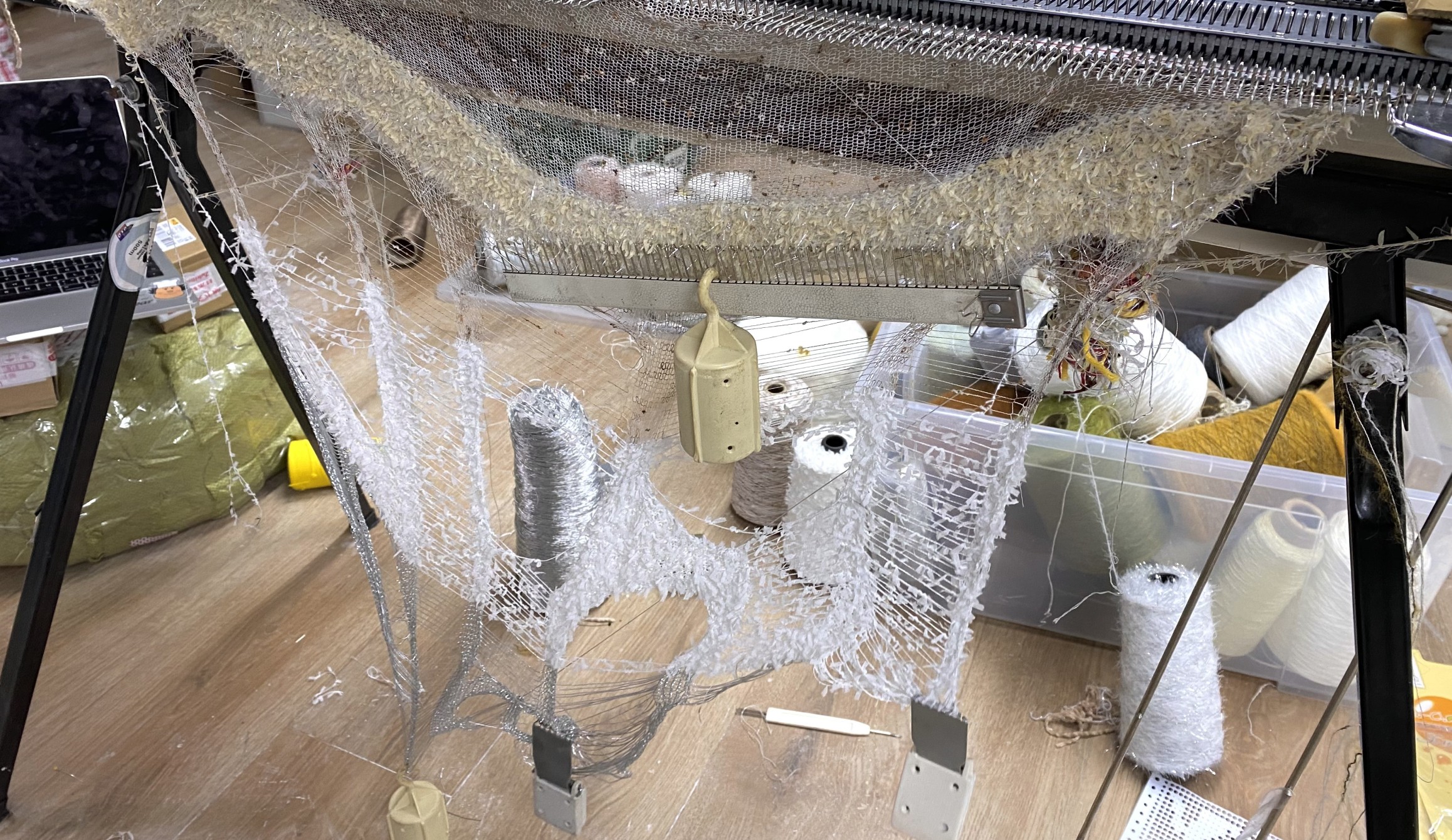
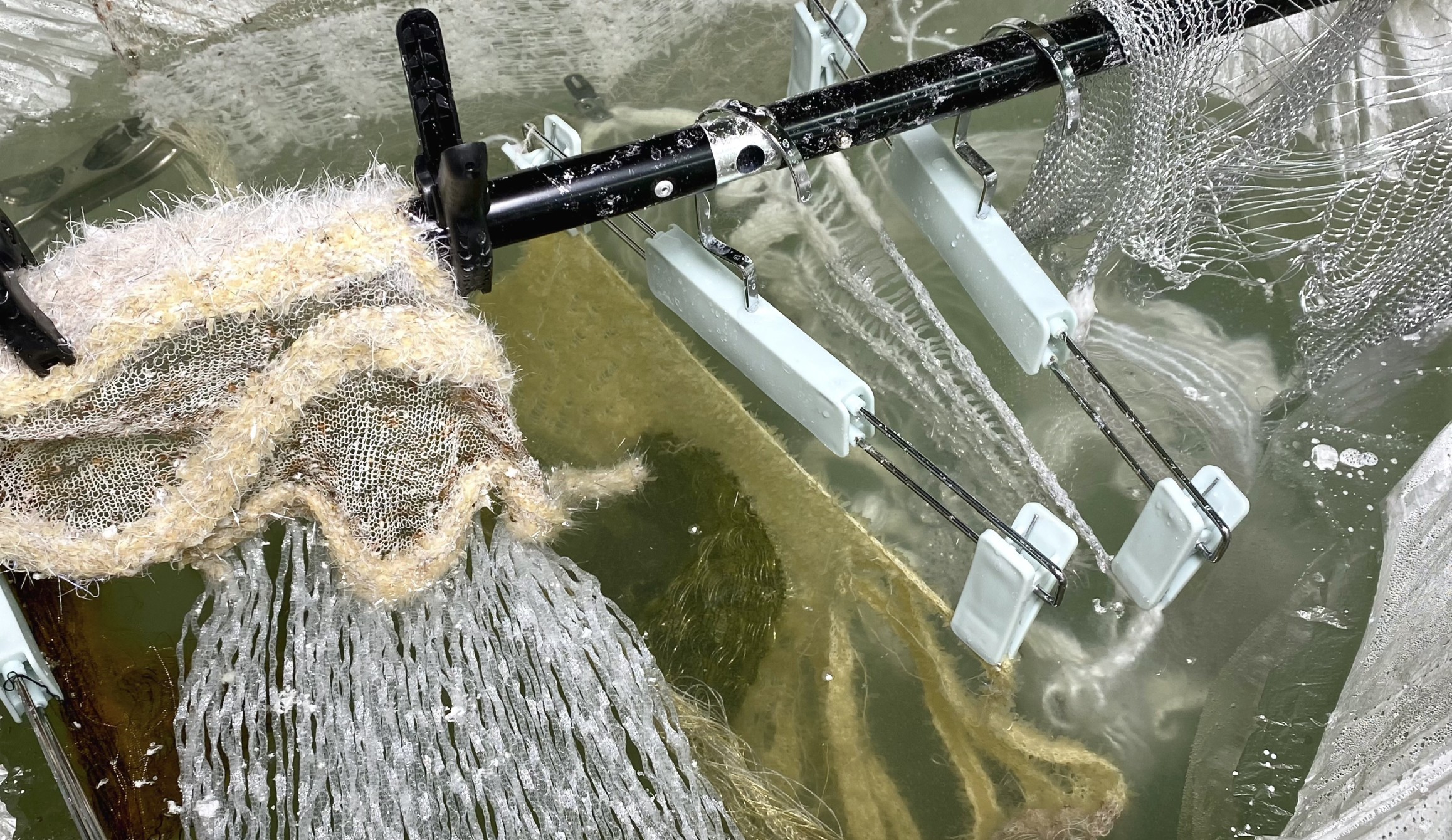
Then Amor Fati, large pieces of woven fabric soaked in a pool of chemical solvent, left to grow its own crystals until they hardened into something like mineral ore. Once formed, I sewed the pieces together until they became something wearable. That took months. You'd check on it daily and barely see it move, slow to the point of feeling almost hopeless. Sometimes it grew wrong, and I'd start over. The process asks for a patience that borders on having no hope of it ever finishing. Then, at the end, it dissolves all at once, in water. Smell first, then sound, then temperature, the feeling of time itself passing.

CNTRFLD. Looking back, were there any moments from your childhood or upbringing that shaped the way you see the world today? Whether through places, memories, stories or everyday experiences, can you trace the beginnings of the artistic language you've developed?

FJY. A lot of this started earlier than I realised.

My parents came from very different backgrounds, and different religions too. In their generation in China, marriage wasn't really built on romantic love; it had more to do with the era, with family pressure. So as a kid, I often lived between two worlds that couldn't fully line up with each other.

When they clashed, I naturally became the one trying to understand both sides. I kept asking myself why one person would think that way, and why the other could not accept it at all. I got used to standing in the middle very early on. That experience was pretty exhausting, and there was a kind of tearing feeling to it. It's a strange position to be in, always trying to understand both sides at once. Later I realised I just kept being drawn to things that resist easy categories.

There's another thread that comes from a very specific bodily memory, and it's also where Damp Town started. I'm from a small island in the south of China surrounded by sea, and every year there's this season called “huínántiān” — the damp return season. The moisture in the air condenses on the walls, the floor, the windows; water runs down the walls, the wooden doors swell up from soaking in all that moisture, and the whole space starts to feel like it has a body of its own. As a kid I just found it annoying. It was only much later that I realised those things I'd taken for granted all my life were shaping the way I see the world.

Then there's the sound of cicadas.  Back home, they always reach your ears before summer arrives. Once your body hears it, you know the season has changed. After I moved to England, that switch never went off again. Is that a kind of loss? I still don't know how to answer that. What I do know is that summer here has never felt fully convincing to me. That dampness, that sound, that temperature — they're not things I “remember”; they've just stayed in my body the whole time.

CNTRFLD. Your practice moves fluidly between sculpture, installation, performance, sound and scenography, with works like Amor Fati, Damp Town and With Each Leap, The Rabbit Breaks a Bell's Tail inviting audiences into immersive, sensory environments. How do you decide which medium a particular idea needs, and what have these projects revealed to you about transformation, vulnerability and the body?

FJY. I don't decide in advance which medium an idea has to match.

Basically, I just let myself experiment freely, whether it works out or not, it counts. A lot of the time something falls apart, and that failure ends up pulling the work in a completely new direction, which is its own kind of surprise.

Like with Damp Town, at the very start, I genuinely never imagined that seven characters would slowly grow out of it. Halfway through, purely by chance, I got into sound production, and it suddenly hit me, why not give this little town its own dedicated immersive soundscape? So, I started carrying recording equipment around, specifically seeking out rainy days to wander into the outskirts, abandoned sites, parks, back paths. I recorded all kinds of sounds, human and non-human, and eventually combined them with my own studio playing and editing together as background.

I really don't over-plan things. An idea arrives, the materials are in hand, and I just keep following it; slowly it becomes what it becomes. I'm not forcibly moulding it into some predetermined shape. I know that might sound a bit mystical, but creation isn't a process fully controlled by me. The materials, the space, the things that happen by accident, they all push back and shape how the work develops. My role isn't to decide what it should become, but to keep listening and responding as I go. It's almost like the work has something to say — like it's the one that finds me.

In residence in Hamburg later also affected me deeply. I'd wanted to work with the stage for a long time, and it was in Germany that I first seriously studied it and got to see so many large-scale, avant-garde live works like Florentina Holzinger and Tianzhuo Chen, etc. That artistic language hit hard, it took me a long time to recover after watching. I noticed that the live works most touch me all refuse that clean, “pure” kind of artistic language, and instead embrace mixture, excess, even a slightly grotesque texture. They're not “performing a story” for an audience to watch, they directly build a temporary world that you walk straight into and stay inside of.

I don't want to make the kind of thing where “here's a sculpture,” and the audience just stands on the outside looking in. What I want to make is more like “here's an event happening,” a living environment with a sense of ritual. Like an artificially constructed ecosystem, an ongoing ceremony, even a kind of small-scale imagined civilisation. Completing that shift from the audience “standing and watching” to the audience “walking in and participating.”

As for what these projects have revealed to me about transformation, vulnerability and the body: transformation never happens according to plan. It's hidden inside the experiments that spiral out of control, fail, or veer off course halfway through.

Vulnerability isn't just a concept I apply to the work. I was diagnosed with hyperthyroidism as a teenager, and it's something I'll likely be on medication for the rest of my life. Before the diagnosis I just thought I was anxious. Then a doctor gave it a name, and I realised something inside my own body, invisible, but not accountable to me, had been setting the pace of both my physiology and my emotions the whole time. Some nights my heart would race so fast I could feel it even lying down. I'd look at my own hand and not be able to make it stop shaking. Who was in charge in that moment, was it me, or was I just watching? I still don't have a clean answer. That's probably where my understanding of vulnerability comes from, before it ever became a subject in my work. It's part of why Amor Fati has edges sharp enough to cut — I wanted the performer to feel, in real time, what it's like when a body can't fully protect or control itself. That lack of solidity is exactly what lets an audience come in and connect with the work. The body isn't a tool for expression either. It's simply a member of that world, living and changing together with all the sounds, objects and space around it.

CNTRFLD. Having lived, studied and exhibited across China, the UK, Germany, the United States and elsewhere, how have these different cultural environments influenced your thinking? Has moving between places changed your understanding of identity, belonging or what it means to make work today?

FJY. It's hard for me to say that any one place gave me some specific influence. It feels more like years of moving around, studying, and exhibiting, and each move meant re-adjusting my relationship with the environment all over again.

When I first got to the UK, the missing cicadas were the first thing I noticed — I've talked about that elsewhere, the way a body keeps expecting a sound that never comes. But it went further than that. It took a while before I understood that the feeling of a place doesn't come from its name or its geography, but from the sensory relationship you've built up with it over years. When that relationship is interrupted, you suddenly realise you've been carrying things you never actually chose to carry.

During my residency in Germany, there were these odd, small moments. I think awkwardness is the most honest vantage point for observation. A lot of the interesting seminars were taught in German, which meant that the courses available to me in English were quite limited.

That's when you realise how language quietly builds an invisible wall. You're not shut out because you lack the ability, but because a certain door was simply closed to begin with. Some thresholds just exist. Or take this: you could smoke inside the building, even during class. It felt strangely contradictory — so rigorous on the surface, but with this strange looseness underneath.

You start noticing the cracks between the official rules and how things run. Or walking down the street, feeling people's eyes on you, directly, unapologetically, that's what made me start noticing how the body gets "read" by a society. Or my boots were too loud indoors, so I switched to a quieter pair. Not out of obedience, but because I'd started noticing how sound changes the way you exist in a space.

I used to think belonging was a kind of security, without it, I'd feel uneasy. But I've slowly come to feel that belonging is more like a capacity: being able to move between different experiences without rushing to settle down completely. Identity, for me, isn't something that has to be pinned down as a fixed label. It's more like a few coins of different currencies sitting in my pocket — different denominations, different weights, each carrying traces of somewhere it's been. They never become the same currency. They just happen to be in the same pocket together and sometimes, when I walk, I can hear them knock against each other.

Video 1

Video 2

Image 1

Image 2

Image 3

Image 4

Image 5

CREDITS

Video 1:

Image 1:

Image 2:

Image 3:

Image 4:

Image 5:

Divider Video:

CNTRFLD. Many artists working across cultures speak about existing between languages, histories or ways of seeing. Has your own experience of migration or living internationally shaped your perspective as an artist, and are there aspects of that experience that you hope audiences — particularly in the UK and Europe — might recognise or reflect on through your work?

FJY. Living between languages and cultures for most of my life, the state I know best is — the word gets to your mouth, then stops there. Some feelings are wet, warm, still holding their temperature in your mother tongue. Once move into another language, they suddenly dry out, go flat, and end up just sitting there, unspoken. But it's exactly in that moment of swallowing the word that the most alive part is hiding. A mistranslated ambiguity. A sensory memory that doesn't quite line up.

Some small detail that just doesn't sit right in its new place. I never expect audiences to "read" some distant migrant experience out of my work. I don't think a person can ever fully step into someone else's experience. What gets touched, in the end, is something already living in your own body. Who hasn't had that moment? It's not the exclusive property of any one group.

What my work does is take that disorientation and turn it into a space you can hear, smell, touch.  No rush to decode symbols, no need to hunt for a correct answer. You walk in, and your body catches that weightlessness first — that strange-yet-familiar feeling. In that moment, maybe you swallow a word too.  And maybe, some night after leaving the show, you'll get up for water at 3 a.m. and find yourself staring, a few seconds longer than usual, at a damp stain on your own ceiling.

CNTRFLD. Alongside your artistic practice, you've also been curating projects such as 02:47–unknown and Almost Home, bringing together artists from different backgrounds in unconventional spaces. What has curating taught you about building creative communities, and why is creating opportunities for others important to your practice?

FJY. Working with Chimimora on Almost Home, this ongoing international programme felt to me more like an experiment in "being together".  What drew me into the programme itself is that it doesn't treat "home" as a fixed location. It's more like a relationship that keeps forming, something that happens in the moment people meet and share a space together. We brought together about thirty artists from different backgrounds and different fields, and the audience itself was also largely made up of artists. People weren't simply looking at a finished exhibition. They were watching each other's work, talking, discussing, sometimes even making things on the spot. My own site responsive piece, "02:47, unknown”, happened in that same environment too. It's a six-minute video, a nameless body curled up at the edge of emotional overload, inside a shelter that's been put together temporarily. I think that's the most interesting part of curating.

You can't fully control what's going to happen. When different people, different practices and different experiences come together in one place, things just happen. People aren't only spectators here. They're part of the ecosystem itself too.

CNTRFLD. Every artist's journey depends, in some way, on the support systems around them — whether that's institutions, residencies, artist-run spaces or informal communities. Drawing from your experiences across different countries, where have you found the strongest sense of support, and where do you think the arts could do more to nurture emerging artists?

FJY. I don't think I've ever found one complete, stable support system in any single place. It's been more fragmented than that, bits and pieces from certain institutions, residencies, artist communities, or very specific personal relationships. It's felt closer to building a lean-to out of whatever happens to be lying around.

A spare desk during a residency. A friend's spare key. A six-month overlap with someone else's studio, before the lease runs out. You patch it together into something that holds for as long as it needs to. Never load-bearing. Always half-listening for the moment it needs propping up again.

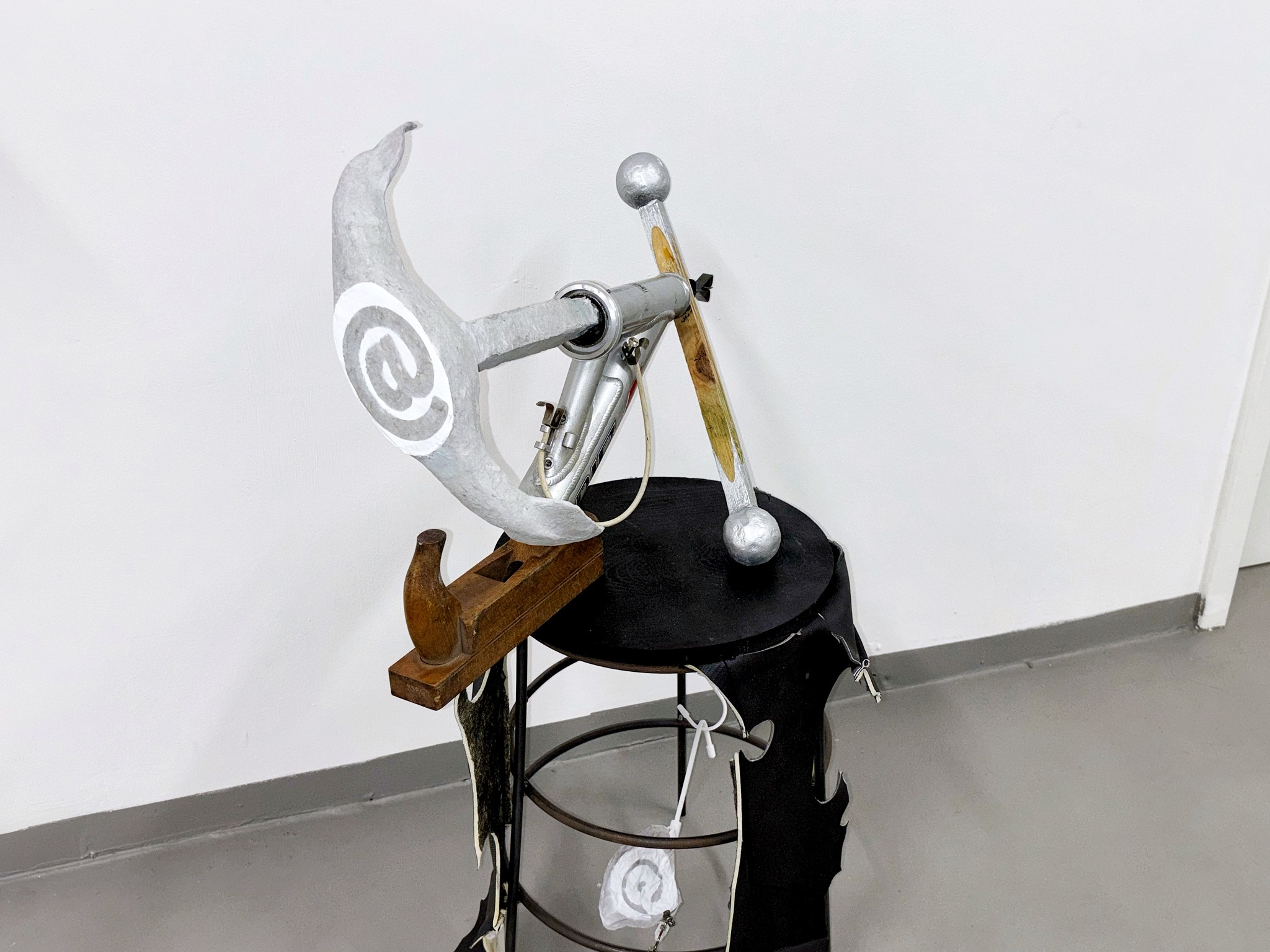
London's art scene has a lot of energy. There are plenty of exhibitions, independent spaces, artists from all kinds of backgrounds. But energy and whether an artist can stick around long-term are two different questions. Competition, cost of living, the pressure of carving out your own position, that's all still very much there. Connection often becomes an invisible form of infrastructure... Without institutional backing, a lot of artists basically end up building their own stage, propping each other up, inventing this informal kind of support system for themselves out of necessity.  Just like the weight and mechanical sound piece in my work’ With Each Leap, The Rabbit Breaks a Bell's Tail’. To the audience it looks like it's just running fine, but really, it's being looked after closely the whole time, adjusted, maintained, so it can keep going. Every system needs ongoing care to keep functioning.

During my residency in Germany, support looked different again. An environment like this gives you more room to experiment, more room to just stay somewhere for a while. For me the most valuable thing wasn't any specific resource, it was that kind of space that lets a piece stay unfinished, that lets a question keep being a question. A lot of my work depends on time and uncertainty in the first place.

Support isn't just about handing out opportunities. It's also about going back and questioning the invisible conditions, the thresholds that make certain practices hard to enter or hard to be understood at all. So, what more could the arts do? Recognise those unseen barriers and make some concrete adjustments, especially for work that's interdisciplinary or doesn't fit neatly into existing categories. What people doing that kind of work need probably isn't to be defined faster, it's time and space to keep exploring. Just finding an affordable studio in central already counts as lucky these days. It could be storage for work, somewhere to work, a residency that doesn't demand instant results, or a chance for different practices to run into each other. These small, almost invisible supports might be exactly what decides whether a practice gets to keep growing.

CNTRFLD. You're currently based in London after spending time working in cities including Hamburg and Shanghai. What keeps you rooted where you are today, and how does your current environment continue to shape the ideas and materials you work with?

FJY. "Rooted" has struck me as a slightly odd word to use for myself. Plants grow roots. What I seem to accumulate instead are boxes.

Goldsmiths is where the work took shape. London was more that things kept attaching themselves to it until there was enough weight to feel. Attachment isn't quite belonging. What people call "rooted" here is sometimes just a nicer word for privilege.

The places show up in the body first, then in the work.  Shanghai. Disinfectant. The diffuser scent of some boutique concept store. An office building's fresh air system, humming low behind a wall. Grease and smoke from a restaurant's back kitchen. A coffee machine, never quite silent. You move from one interior to the next, never once touching the outside temperature. Clean lines. Straight lines. Maintained. Something faintly new-wave, fashion-adjacent, in the air.

Xiamen, where I grew up. Typhoons. Huínántiān. Heat that arrives already wet. Five minutes outside and you give up on staying dry. Sea air. Damp concrete. Oil from a roadside fryer. That bitter smell of plants baked all day in the sun. Walls mottled, spotted, negotiating with the moisture instead of resisting it. You stop. You feel it. Before doing anything else.

Hamburg, low, flat, grey light that never really lifts past midday, everything slightly underexposed, colours drained down to almost nothing. Corridors. Thresholds. Roads planned, buildings defined, space allocated down to the last metre. You felt it everywhere, that you were standing inside something designed. Planned. Measured. Assigned a function.

London does none of that properly. Just drizzle, half-hearted, most of the year. Mice in the walls at night. Damp patches spreading at their own pace, in place of the mosquitoes and cockroaches of my childhood summers.

I don't know what my next step is. But the work has learned to migrate along with me, wherever the next place turns out to be.

CNTRFLD. Finally, as someone whose practice embraces experimentation, patience and uncertainty, what advice would you offer to emerging artists who are trying to build a sustainable creative life while staying true to their own voice? And what projects or ideas are you most excited to explore next?

FJY. Don't fix yourself into a shape too early.  Style, material, a single narrative line, all easier to get recognised by, easier to get absorbed into a system. But your own language takes time to find its grammar, and that doesn't happen only in the studio. It happens when you change cities, change studios, talk to people who see things differently, make something that completely fails.  Sometimes you only hear what you meant to say inside a piece that's already spiralled out of your control.

About next ideas: Underwater. Man-made objects that have gone feral, propellers, shipwrecks, industrial debris that's sat long enough beneath the surface to stop being industrial at all. These things were built to be used, maintained, kept in check. Then they sink, and something changes.

They still carry our fingerprints, but they no longer require us. 

Water is the interesting part, it scrambles distance, direction, sound, even where your own body ends. You catch a fragment, an outline, and your imagination just runs with the rest. What unsettles me isn't the idea that these things might turn on you. It's that they wouldn't notice you at all. (Cosmic indifference). The other stays on land. It's a different kind of unease. I keep coming back to structures built inside what you'd call a "constructed environment," something engineered entirely around human need, that have since lost whatever they were built for. 

A derelict industrial building shaped like something that once wanted to fly, a former sanatorium, a shuttered club, a hollowed-out limestone quarry, where I visited in Germany. They all carry that particular last-century futurist romance, capital's own version of glamour, except the glamour was always resting on something more exploitative underneath. The moment the function drains out, all of that gets flattened into something else: a gorgeous ruin, a backdrop, a spectacle you photograph rather than a history you're asked to sit with. What unsettles me here isn't the ruin once it's already been aestheticised. It's the narrow window just before that, when a structure has stopped doing what it was built to do but hasn't yet been forgiven into scenery.

Maybe what connects them isn't the objects at all, it's what happens once control walks off the job. Whether the world just keeps going quietly on its own terms, indifferent to you, or gets dressed back up and sold as something to look at. I'd like to grow one of these, maybe both, into something bigger, a large-scale immersive piece, if I ever get the room to do it.

Image 1:

Image 2:

Image 3:

Image 4:

Image 5:

Image 6:

Image 7:

Image 8:

CREDITS

Image 1:

Image 2:

Image 3:

Image 4:

Image 5:

Image 6:

Image 7:

Image 8:

About the artist.

Freja Jiahui Ye is a multidisciplinary contemporary artist working across sculpture, installation, sound, performance and scenography. Based in London, her practice explores material transformation, sensory experience and the unstable relationships between bodies, objects and environments.

Drawing on dramaturgy, alchemical processes and systems of measurement, Ye works with materials and conditions that are difficult to fully control, including crystallisation, dampness, decay, magnetism, sound and environmental change. Her practice brings together the human, mechanical and non-human, often connecting contemporary art with folklore, ritual, science and speculative world-building.

Rather than treating artworks as fixed objects, Ye creates situations in which materials, spaces and audiences can influence one another. Her work frequently develops through experimentation and site-responsive processes, allowing unexpected outcomes, failure and transformation to become part of the work itself.

A key concern within Ye's practice is the relationship between control and vulnerability. Her installations, performances and immersive environments invite audiences to experience works through multiple senses, challenging the conventional distance between artwork and viewer. She is interested in creating temporary worlds or ecosystems in which bodies, objects, sound and space coexist and continually affect one another.

Ye holds a BA in Fine Art from Goldsmiths, University of London and was selected for a residency at the Hochschule für bildende Künste Hamburg (HFBK Hamburg). Her work has been featured in Numéro Magazine and exhibited across the UK, Germany, the United States and Asia.


Freja Jiahui Ye — Artist Website

Share Article

Share Article

More to Read