Ze-Cheng illustrated by Maria Chen

DATE

2026/08/03

ARTICLE

Maria Chen

PHOTOS

Courtesy of the Artist

IN CONVERSATION Ze-Cheng Li: Where Wind Begins

The London-based contemporary artist on perception, memory, diasporic identity and the invisible forces that shape how we experience space.

What if the most meaningful encounters are the ones we almost fail to notice?

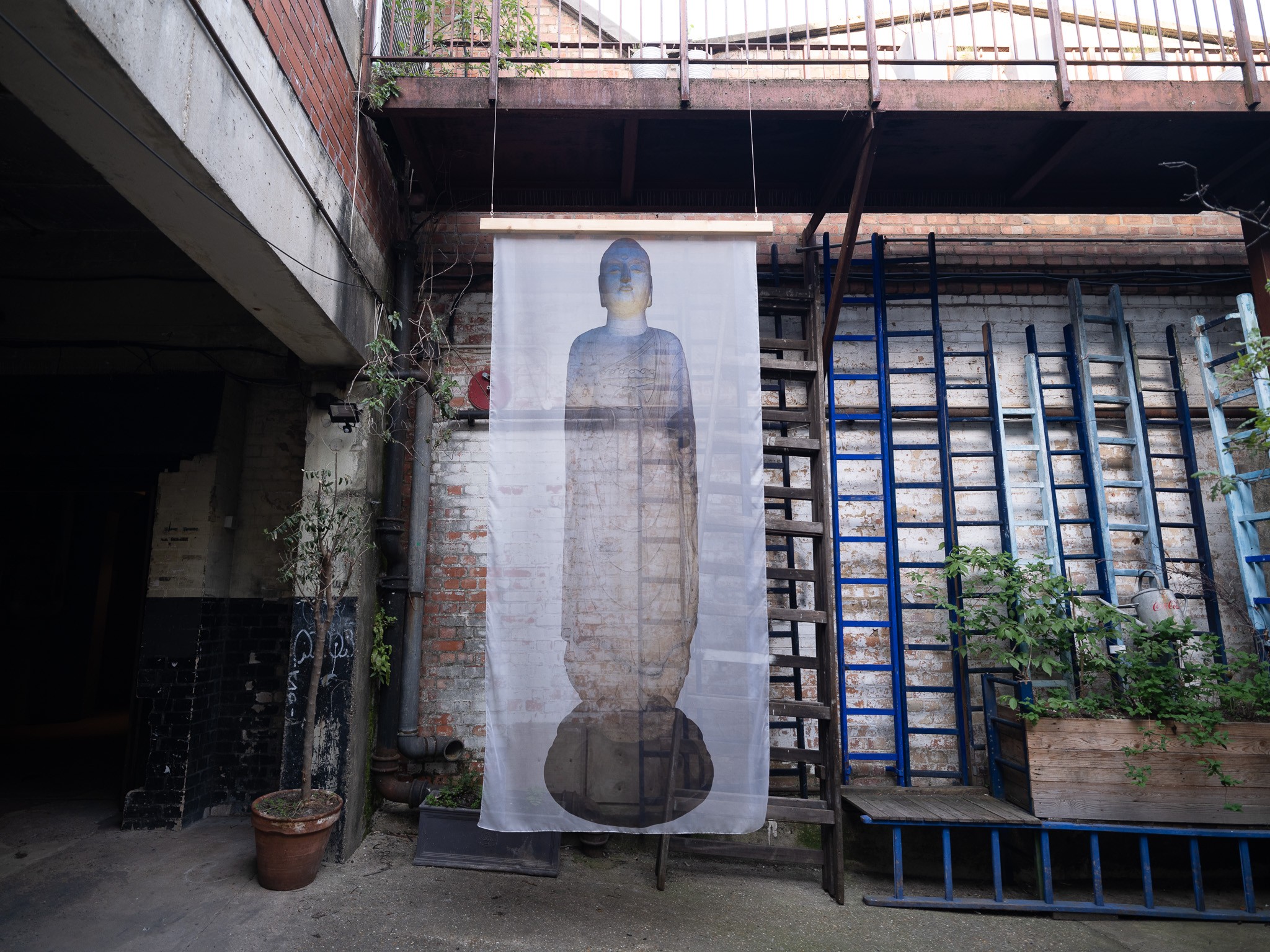
For London-based contemporary artist Ze-Cheng Li, the invisible movement of air left behind by a passing stranger can become the starting point for an entire exhibition. His latest solo exhibition, Where Wind Begins, invites audiences to reconsider the subtle, often overlooked forces that shape our experience of the spaces around us.

Working across installation, photography and moving image, Li creates immersive environments in which light, airflow, translucent materials and the movement of visitors become active participants. Rather than presenting fixed narratives, his installations evolve in dialogue with their surroundings, inviting viewers to inhabit the work rather than simply observe it.

Educated at Camberwell College of Arts before completing an MA in Contemporary Art Practice at the Royal College of Art, Li draws on phenomenology, material experimentation and everyday observation to explore memory, perception and diasporic experience. Living between cultures has informed a practice that understands identity not as something fixed, but as a continual negotiation between body, place and time.

In this conversation with CNTRFLD.ART, Li reflects on the origins of Where Wind Begins, the influence of diasporic experience on his practice, and why uncertainty has become central to the way he makes work. He also discusses urban transformation, the need for sustained support for emerging artists, and the enduring influence of thinkers including Maurice Merleau-Ponty and Byung-Chul Han.

Previous

Next

Previous

Next

CREDITS

Header Video: Come by the Wind Series

Slider 1-4: Duft der Zeit 2026 print on chiffon, moving image

"When a stranger passes by, they leave behind a small movement of air… I've come to think of that movement as a trace of another life crossing my own." — Ze-Cheng Li

CNTRFLD. Your solo exhibition Where Wind Begins centres on movement, atmosphere, and what you’ve described as “invisible forces”. Could you start by talking us through how this body of work came into being—what first set it in motion?

ZCL. I don't think the work began with an idea. It began with a habit. I've always enjoyed walking without a destination. If I have time, I'll take my camera and wander through streets and alleyways for hours. I'm not looking for a particular image. I'm waiting for something to happen—to my attention, to my body, to the space around me.

One experience has stayed with me for years. When a stranger passes by, they leave behind a small movement of air. I don't know who they are, and I'll probably never see them again, but for a brief moment the wind they leave behind meets me. I've come to think of that movement as a trace of another life crossing my own. Every passer-by carries a story, even if that story remains unknowable.

That feeling eventually became Where Wind Begins . I wasn't interested in representing wind as a natural phenomenon. What interested me was the possibility that something almost imperceptible could reveal the presence of another body, another journey, another way of inhabiting the world. Perhaps that's where all my work begins—not with images, but with encounters.

CNTRFLD. There’s a strong sense in your practice of things never quite settling—images appearing and dissolving, materials responding to air and light. What draws you to this state of instability, and how did it become central to the way you work?

ZCL. I don't experience the world as something stable. Even the most familiar places are always disappearing as we move through them. A simple example is sitting on a bus. You might travel the same route every day, looking at the same buildings through the same window, but that landscape only exists for a few seconds. The bus keeps moving, the image slips away, and before long you've arrived somewhere else.

What seems permanent is actually made up of countless passing moments. I'm interested in working with materials that behave in the same way. Mesh, translucent fabric and suspended images never completely settle. They respond to air, to light and, most importantly, to the presence of people moving around them. The work is never entirely still because our experience of the world is never entirely still. I'm less interested in preserving memory than in remaining faithful to the fleeting nature of perception itself.

CNTRFLD. You’ve spoken about identity not as something fixed, but as a shifting condition that continually repositions how you understand space and presence. How has your own experience shaped this way of thinking—and how consciously does it enter the work?

ZCL. My experience has definitely shaped this way of thinking, but I do not want the work to become only about myself. I am interested in the self as something more open. When I say “myself”, I often think of it as something shared — not only me as an individual, but any body moving through the world and trying to establish a sense of place.

Living between different cities and cultures has made me aware that identity is not something solid. It is constantly repositioned by language, memory, architecture, movement, and the people around us. But rather than representing identity directly, I prefer to create situations where viewers can sense this shifting condition through their own bodies. In that sense, the work does not ask the viewer to understand my identity. It invites them to enter a space where they may become aware of their own.

CNTRFLD. Thinking back to your early life, are there particular moments, environments, or influences from your childhood or upbringing that you now recognise as formative in your practice?

ZCL. Looking back, I think my sensitivity to disappearing places comes from growing up around environments that were constantly changing. Streets, buildings, neighbourhoods, and domestic objects could disappear very quickly. At the time, I may not have fully understood what that meant, but later I realised that these changes had shaped how I think about memory and place.

My series Blind Alley came from this feeling. It is connected to childhood memories, but also to the way urban renewal can erase the emotional texture of a place. I was interested in how materials such as concrete, metal, resin, lace, and old domestic fragments could hold traces of something that no longer exists. So my childhood did not influence me through one single event, but through a repeated awareness that places are fragile. They can be removed physically, but emotionally they continue to echo.

CNTRFLD. Your work often feels as though it sits between places—between presence and absence, image and environment. For audiences in the UK and Europe, how do you reflect on your own diasporic experience within this, and what it means to make work from that position?

ZCL. Making work from a diasporic position means that place is never completely given. It has to be sensed, approached, and slowly built. I do not feel that I simply belong to one fixed location. Instead, I am always negotiating between different memories, languages, and spatial experiences. This condition has made me more attentive to the gap between space and place. A space only becomes a place when we experience it, when our body begins to form a relationship with it.

This idea is close to Yi-Fu Tuan’s thinking, but for me it is also something very personal and bodily. In the UK and Europe, I often feel that I am moving through spaces that are familiar and unfamiliar at the same time. This in-between position allows me to remain open. I do not take place for granted. I have to keep sensing it, and that process becomes part of the work.

Image 1

Image 2

Image 3

Image 4

CREDITS

Image 1-3: Come by the Wind Series

Image 3: Across 2024 print on organza

Image 4: Leer Series

Divider Image: Us 2026 ginkgo leaves, silk, ogrganza, chiffon

CNTRFLD. You studied at both Camberwell and the Royal College of Art. What drew you to the UK for your arts education, and how did those experiences shape your approach—both in terms of thinking and making?

ZCL. Coming to the UK gave me a different way to understand art-making. At Camberwell, I became more aware of material, process, and the relationship between image and object. It allowed me to move beyond photography as a flat image and begin thinking about how images could occupy space.

At the Royal College of Art, my practice became more expanded and more theoretical. I started to understand my work not only through memory or urban experience, but through perception, phenomenology, and the body. The RCA also gave me the space to test installation as a way of thinking — not just as a final form, but as a condition that allows viewers to experience something physically. These experiences helped me realise that I am not only making images. I am creating conditions for perception.

CNTRFLD. Having worked and studied across different contexts, how would you describe the kinds of support systems that have mattered most to you? And where do you feel there are still gaps, particularly for emerging artists navigating similar paths?

ZCL. The most important support has come from conversations — with tutors, friends, other artists, and people who are willing to look carefully and ask serious questions. For an emerging artist, especially one working between cultures and disciplines, this kind of dialogue is very important. It helps you understand what is already inside your work before you can fully name it yourself.

Material and institutional support also matter, of course: studio space, exhibition opportunities, funding, and time. But I think one of the biggest gaps is the lack of sustained support after education. Many emerging artists are expected to immediately become independent, but building a practice takes time, uncertainty, and failure. I think artists need structures that allow them to continue developing slowly, rather than constantly producing finished outcomes.

CNTRFLD. Your installations seem to invite viewers into a kind of slowed, perceptual experience rather than offering a fixed reading. How do you think about the role of the viewer—what do you hope they encounter or become aware of in that space?

ZCL. I often think of myself less as the author of an experience than as someone opening a door.  I don't believe an artwork needs to be understood in the same way by everyone. Each person enters carrying different memories, different histories and different ways of seeing. My responsibility isn't to tell them what the work means. It's simply to create the conditions in which something meaningful might happen.

When people walk through the installation, their bodies disturb the air. The wind they create causes the suspended images to move almost imperceptibly. In that moment they realise they aren't just observing the work—they're participating in it.

If the exhibition succeeds, I don't hope people leave with my ideas. I hope they leave slightly more attentive than when they arrived: more aware of the wind behind them, of strangers passing by, of the quiet relationship between their bodies and the spaces they inhabit.

I've often thought that my work is less like a narrative than an echo chamber. You call into it, and what comes back isn't my voice—it's your own.

CNTRFLD. Where are you currently based, and what keeps you there at this stage in your practice? Does place still play an active role in shaping how and what you make?

ZCL. I am currently based in London. London continues to shape my practice because it is a city of movement, crossings, temporary encounters, and constant transformation. It is a place where many people pass through, carry different histories, and build different forms of belonging.

For me, place is not only a background. It is active. It affects how I walk, how I photograph, how I choose materials, and how I understand the relationship between body and environment.

At this stage, being in London allows me to remain within a condition of in-betweenness. I think that is important for my work. I need to be in a place where things are not completely settled.

CNTRFLD. Looking ahead, what are you working on now—or beginning to think towards next? And for those at an earlier stage, what advice would you offer about sustaining a practice that feels both personal and open-ended over time?

ZCL. I am currently thinking more deeply about perception: how we can return to the real space around us when contemporary life is filled with too much information, speed, and fragmented narrative. I have been reading Byung-Chul Han and thinking about the crisis of narration, as well as Maurice Merleau-Ponty’s phenomenology of perception. His idea that the body is our way of having a world feels very close to my practice. I am interested in how art can create a pause — not to escape reality, but to return to it. My work is not trying to change the world directly or claim a political solution. I hope it can leave people with a moment in which they recover their ability to feel the space they are already in. I often think of my work as an echo chamber or echo wall. If you call into it, what comes back is not my answer, but your own echo. Art cannot build a place for the viewer, but perhaps it can remind them that they still have the ability to build one.

For artists at an earlier stage, I would say: do not rush to define your practice too quickly. Stay close to the small experiences that keep returning to you. Sometimes the most important part of your work begins from a very simple bodily habit — walking, looking, touching, remembering. Trust that, and allow the work to reveal its own language over time.

CREDITS

Video 1: Duft der Zeit 2026 print on chiffon, moving image

Video 1

Image 1

Image 2

Image 3

Image 4

Image 5

Image 6

CREDITS

Image 1-3: NO:14 2024 Chinese ink on rice paper, silk, iron, copper

Image 4: Untitled 2021 cement, rattan chair

Image 5-6: Replacement and Demolition 2024 tiles, coloured tiles, glass blocks, steel frames, wheels

About the artist.

Ze-Cheng Li (also known as Loic Ze-Cheng Li) is a London-based contemporary artist whose practice explores the relationship between material, memory and perception through installation, photography and moving image. His work creates immersive environments in which light, airflow, translucent materials and the movement of visitors become integral to the experience of the work.

After studying Fine Art Photography at Camberwell College of Arts, University of the Arts London, Li completed an MA in Contemporary Art Practice at the Royal College of Art. His interdisciplinary practice extends beyond the photographic image, investigating how perception is shaped through space, time and embodied experience.

Rather than presenting fixed narratives, Li's installations embrace transformation. Semi-transparent materials respond to changing light and air, allowing images to emerge, shift and disappear, while encouraging viewers to become active participants in the work.

His recent solo exhibition, Where Wind Begins (London, 2026), continues this investigation through an installation shaped by everyday observations, architecture and the movement of bodies through space. Across his practice, Li approaches identity and place as fluid, lived experiences formed through memory, movement and continual change.


Solo Exhibition

“Where Wind Begins”
GREATOREX street
London E1 5NF

9–12 April 2026 


With thanks to Eulan To and East End Chinatown for facilitating this conversation.

Share Article

Share Article

More to Read