Binti illustrated by Maria Chen

DATE

2026/07/13

ARTICLE

Maria Chen

PHOTOS

Courtesy of the artist

Binti: Memory, Paper and the Language of Everyday Life

The Malaysian multidisciplinary artist discusses Jawi, self-portraiture, paper as archive, artistic autonomy, and finding universal stories through deeply personal acts of making.

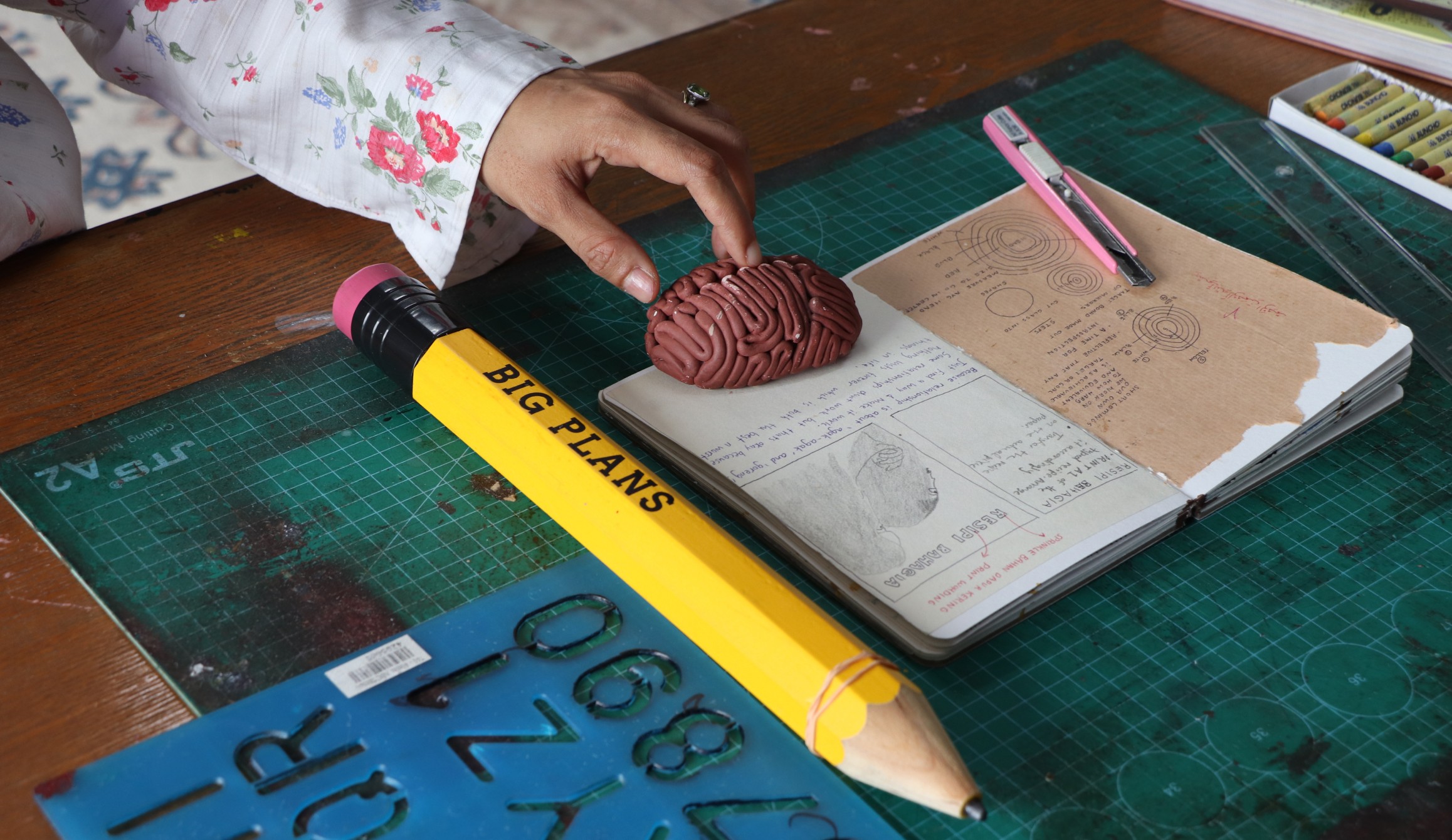
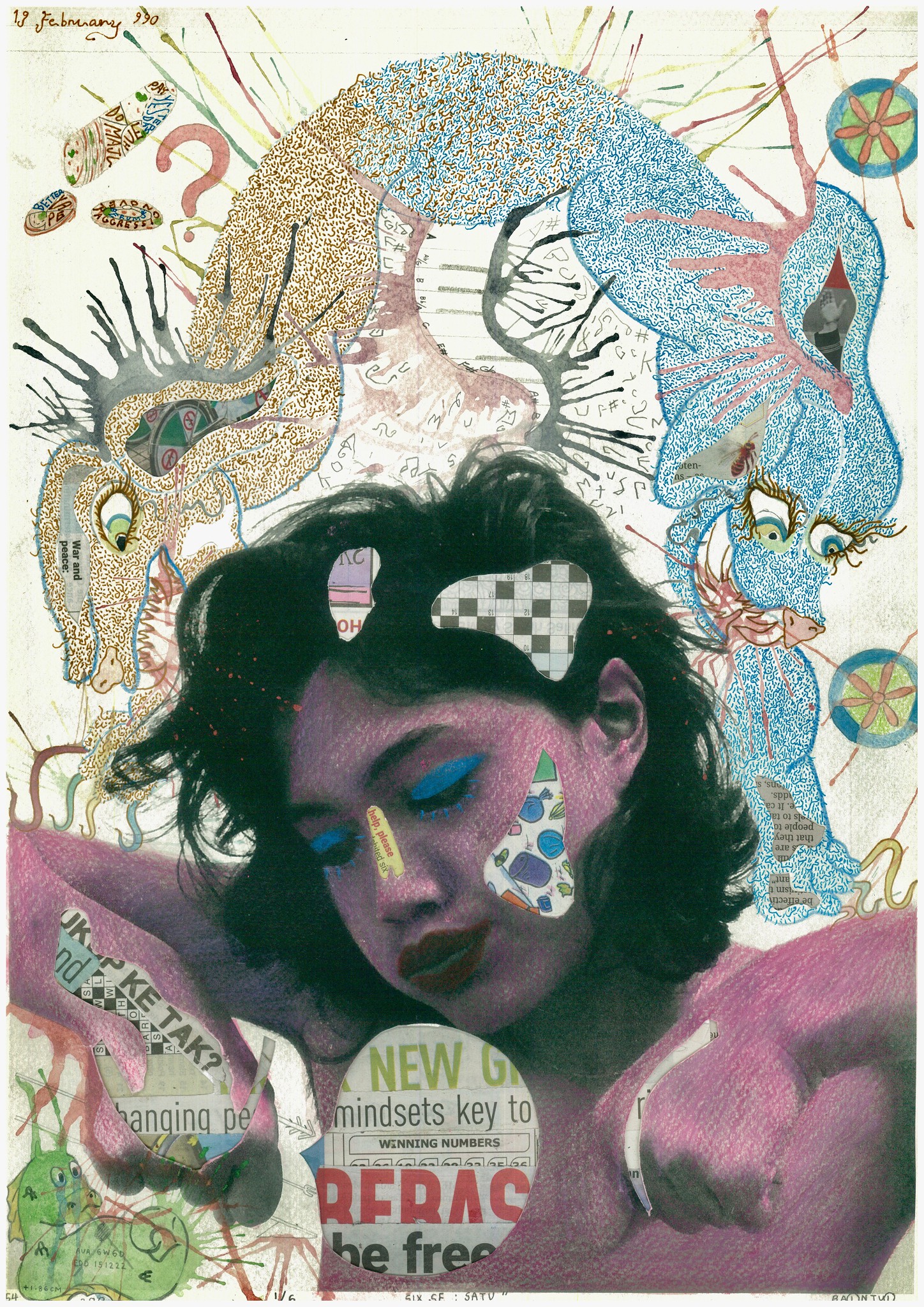
In an era increasingly shaped by spectacle, speed and digital excess, Malaysian artist Binti offers something quieter yet no less compelling. Working across drawing, collage, photography, film, literature and Jawi script, her multidisciplinary practice returns repeatedly to paper—its fragility, familiarity and extraordinary capacity to hold memory. Through handwritten texts, found materials and personal archives, she transforms everyday experiences into nuanced reflections on identity, language and belonging.

Born in Johor Bahru in 1998 and now based in Kuala Lumpur, Binti belongs to a generation of Southeast Asian artists whose practices move fluidly across disciplines without being defined by any single medium. Educated in Cinematic Arts and Malay Literature, she allows each idea to determine its own form, creating works where poetry becomes painting, photographs become performance, and fragments of conversation evolve into moving image.

At the heart of her practice is an ongoing exploration of memory—not as nostalgia, but as a living material shaped by language, cultural inheritance and lived experience. Her recurring use of Jawi script is central to this enquiry. Rather than treating it as ornament or symbol, Binti reactivates the historic Malay writing system within contemporary practice, opening wider conversations around translation, identity and cultural continuity.

Equally characteristic is her diaristic approach to making. Whether through self-portraiture, collage or handwritten text, autobiography becomes less an act of confession than a way of exploring shared human experience. Questions of intimacy, labour, gender and vulnerability emerge naturally, inviting viewers to recognise something of their own lives within hers.

Binti first gained widespread attention through Tuju One, a series of 24 paper works presented in Titik Garis Bentuk at ILHAM Gallery, where she was the youngest participating artist and the only artist of her generation. Her solo exhibition Sesuatu Yang Something further established paper as both the conceptual and material foundation of her practice, while her films have been presented internationally, including at the Chicago Architecture Biennial, the Malaysia Pavilion at Expo 2025 Osaka and SeaShorts Film Festival.

This conversation arrives at an important moment in her career. Ahead of her second solo exhibition in 2027, Binti is preparing new work for exhibitions in Kuala Lumpur and the Pattani Biennale, while undertaking a three-month residency with the Goethe-Institut and Basis e.V. in Frankfurt. As her practice reaches increasingly international audiences, questions of translation, cultural specificity and artistic autonomy become ever more pertinent.

In this conversation with CNTRFLD.ART, Binti reflects on growing up between Johor Bahru and Kuala Lumpur, reclaiming Jawi through contemporary practice, the enduring significance of paper, the role of self-portraiture, and the support systems that have sustained her journey. What emerges is a practice rooted in the everyday yet expansive in its cultural reach—one that reminds us how ordinary materials can become powerful vessels for memory, connection and shared experience

Previous

Next

Previous

Next

CREDITS

Header: In Person, Artist Talk Solo Exhibition

Slider 1: Process, Play

Slider 2: Artwork, SOLDOUT!

Slider 3: In Person, Artist Talk Solo Exhibition

Slider 4: Process, Drawing

"Art is not everything but everything is art."—Binti

CNTRFLD. You were born in Johor Bahru and later moved to Kuala Lumpur. How did those early environments shape your visual language, and when did you first recognise art as a viable form of practice?

BP. Each state in Malaysia has its own tagline, and Johor Bahru’s is “JB Tak Bosan”, (JB Is Not Boring). And I’d defend that. Johor Bahru and Kuala Lumpur are very different to me in terms of pace of work and living. Johor Bahru is a coastal town and the drive into the central city involves passing by a beach so to me it is more forgiving compared to a metropolitan like Kuala Lumpur. In 2026, there are more developments than ever in Johor Bahru and with it, a growing demand for art related events and activities. I grew up in this state that didn’t show the possibility of consistent creative work, there aren’t any art galleries besides a singular cultural center and a biographical museum.

Then I moved to the capital city where there are so many spaces and galleries that champion local artists regardless of how bona fide or unrecognised these spaces were, the impact to me was that they existed. The initial thinking that art could be a career path came to me early through growing up with TV and my mothers’ magazines, seeing names listed in the credits after cartoons with words like ‘animator’ and ‘story writer’ or in the first sleeve of these magazines with terms like ‘editor’ and ‘art director’. It opened my mind as a child that there were actual human beings behind what I was consuming even though at the time I wasn't sure if this was a real ambition in the context of Malaysia, I always thought I had to migrate to have these experiences.

Moving to Kuala Lumpur where I spent my teen and twenties, and later getting to know local artists, musicians, designers, writers, cultural workers with Malaysian context in their works further solidified to me that this was an actual industry that exists and that I, like many Malaysians, felt far from it because I lacked the education and exposure.

CNTRFLD. As a Malaysian woman working across media, how do questions of identity—cultural, gendered, or otherwise—surface in your work, and how resistant are you to framing it through those terms?

BP. When it comes to questions of identity, my reclamation happens through very specific, physical choices. For instance, my active use of paper as a main medium, as an immediate, accessible source drawn from my habit of hoarding scrap paper, notes, and using cheaply found office supplies. When I use techniques like embossing text into paper, I am physically changing its texture which mirrors how we carry these invisible indents of our own cultural or gendered conditioning. These identity markers are inescapable for me, but it shows up more like personal journalism than a political manifesto. Choosing the moniker "Binti" was a very deliberate nod to that, how it’s deeply personal, yet it’s the most commonplace marker in identifying ones’ gender, religion or tribe. Because of this, cultural and gendered questions naturally surface in my work because I operate as a diarist, capturing the immediate world around me whether that's my mother captured right after prayer in her telekung, or the messy reality of freelance creative labour in my Funemployed series. My work is a nuanced exploration of external perception versus self-acceptance. Ultimately, I want the audience to connect with the texture, stories, and the layers of the craft. 

CNTRFLD. Your practice moves between collage, photography, video, painting and text, often refusing medium-specific resolution. What does this refusal allow structurally within the work, and how do you determine when a work has stabilised?

BP. The medium remains material inquiries that are secondary to the story. The flexibility in moving between mediums is both subconscious and strategic. I tend to gravitate towards uncomplicated materials such as paper, paint, a camera, everyday accessible home or office objects and stationery. From the point of ideation to execution, it almost becomes a game I play with myself - How soon can I bring an idea to life? Even if it isn’t the finished product straight away. It takes its own course, from a poem to a painting or a prompt in my notebook I scribbled from hearing a funny sentence someone said to becoming a dialogue in one of my films. I simply shepherd the works where they want to go, and it tells me when we have arrived. 

CNTRFLD. There is a recurring self-reflexive presence in your work, including the use of your own image. What does self-portraiture enable within your practice that other strategies of representation do not?

BP. Self-portraiture is the most immediate extension of my core ethos, which is exploring the intricacy of the human spirit through intimate mediums. What self-portraiture enables that my other modes of artmaking cannot is uncompromised immediacy. In line with my practice of using uncomplicated methods, it is this frictionless simplicity that encourages me to document on my own terms. When I use myself as the subject, to me, it is an oxymoron - performing sincerity. By being both the object and subject, I am allowing myself the space to question my beliefs, ideologies and what it truly means to look with my natured female gaze and not through the lens of nurtured social standards and misogyny I’ve internalised. In capturing myself, I don't overthink the ethical weight of misrepresenting someone else. I bare my pores and personhood as it is that day. 

Paradoxically, using my specific face and image makes the work more relatable, not less, which is feedback I often receive in messages and letters from people who connect deeply and personally with the work. When viewers see me navigating these spaces, it ceases to be a generic commentary, instead, it becomes an invitation for the viewer to think about their own interior landscapes. Self-portraiture ensures that I am never just a passive observer pointing a finger at a concept, it forces me to be fully present inside the thought and the artwork holding up a mirror to myself so that the audience can comfortably look into it too. For me, self-portraiture is the organic extension of my diaristic practice. If I’m going to make work with raw and unfiltered themes, I can’t ask an audience or another subject to be in touch with their own stories if I’m not willing to do it myself. 

CNTRFLD. Your incorporation of Jawi script and textual elements carries layered cultural and affective registers. How do you position language in your work—as image, as material, or as a site of recovery?

BP. I relate Jawi with my two upbringings between culture and religion. Islamic religious text is primarily written in Arabic as it is the language of the Qur’an, while my mother tongue, Bahasa Melayu, had Jawi as its initial writing system for 600 years up until the 1960’s when it was replaced with Rumi (Latin script) initiated by colonial forces and solidified by nationalist groups to standardise, modernise and increase literacy rates.

I did not live through this live transition but growing up in Malaysia when I did, I picked up on the fact that Bahasa Melayu is digraphic language seeing street signs written two ways or meeting older generations of Malaysians who neither Malay or Muslim being able to read and write in Jawi. It was eye-opening to me as someone who had only related Jawi through an Arabic, and directly, Islamic lens. There still remain some states in Malaysia where it is mandatory to have shop signage and signboards including Jawi script so even a place like a nightclub would be labelled in Jawi alongside its Rumi counterpart. Even so, there are a handful of Malaysians who are protective over the use of Jawi as a writing system that they deem sacred because it is the written script of religious texts. 

There is a lingering tension in accepting its use for any other purposes including artwork that isn’t aligned with their personal views which I believe is due to a lack of exposure and reasoning about its use and history. Eight years of my life were dedicated to attending Islamic Religious School alongside my regular primary and secondary school. The textbooks were in Jawi, and the assignments and exams required you to write longform in Jawi. So much of its translation in my current bodies of work is attributed to it being this writing system I’ve learnt and practiced in my former years. To me, when I use it in my works, I mean well and my sincerity and appreciation of it is obvious. It is a script that I love, want to share and preserve through my own contemporary application. 

Video 1: Artwork, Octiber 1-3

Image 1: Artwork, Resolutions

Image 2: Artwork, Sixse

Image 3: Artwork, Sixse

Image 4: Process, Artist Studio

Image 5: Process, Painting

CREDITS

Video 1: Artwork, Octiber 1-3

Image 1: Artwork, Resolutions

Image 2: Artwork, Sixse

Image 3: Artwork, Sixse

Image 4: Process, Artist Studio

Image 5: Process, Painting

Divider: Artwork, Big Girl

CNTRFLD. Looking at earlier works such as Is this a political statement? and Selamat Hari Sunday, how do you understand the relationship between those performance-based gestures and the more materially varied language of your current practice?

BP. Regardless of medium, there is always an undertone of performative-ness to my works which is a term I don’t deem derogatory. Ten years ago, I was painting myself blue or interviewing myself about anatomical autonomy and acting out subversively improvised or choreographed ideas in front of a camera with the only intended audience being the internet. At this point in time, I did not know the term ‘performance art’ or understand that this urge to express this way has its merit, history and acknowledgement through the proper channels. The only person I knew that was doing what I was doing was myself, so my pool of references was small, which is why the initial recorded performances were so simple, unpolished and special because I never learnt how to do it like anyone else. 

I fell into art by chance from doing what I love. I started by performing as the person I wanted to be. Someone who is able to translate personal disorder into synergetic creativity. Who draws, writes poetry, makes films and takes photographs. It is both separate and sewn into the fabric of my being. It is this exact active awareness on the aspect of performance that becomes my way of being sincere. My own physicality is often at the forefront of the photography or drawing works on paper, my own stories and experiences in the poetry I write. All these representations accumulate to platform a presence above all else and a reclamation of my time, thinking, energy, space, autonomy. It is exercising full custody of these components in my life that I do not take for granted through expression that is up for interpretation but most importantly, knowing my values and principles of this expression when no one is clapping or looking. 

CNTRFLD. Early presentation contexts such as The Backroom KL are often significant for emerging practices. What did working within those infrastructures enable in terms of audience formation and critical positioning?

BP. I worked with The Backroom KL through my friend and fellow artist, chitoo, who was producing this group exhibition called ‘Favouritism is my favourite-ism’ in 2023 where he explores the power dynamic of the art industry. He deliberately curated a line-up of only his favourite artists stating that this is the way art circulates and artists contextualised based on the opinion of a small group of people. 

I’ve also worked with the critically acclaimed writer, Ellen Lee, who is also a part of The Backroom’s core team. She wrote the revered exhibition essay for my solo presentation in 2025. Liza Ho herself is a gallerist that I deeply admire and respect for her love of both the players and the game. I could reach out to her with wild ideas, and she would see the possibilities in bringing them to life. 

What working within these infrastructures introduced me to is that there are villages of interesting individuals that are actively dedicated towards platforming and moving the needle in the context of Southeast Asian art towards a global scale and that it is far from lonely in this shared communal mission.

CNTRFLD. Your work has also been presented in the UK, including Adult Lovesong. How did encountering a different institutional and cultural reading context recalibrate, or confirm, your understanding of how the work circulates?

BP. Showing Adult Lovesong in the UK confirmed that human intimacy, loneliness and the desire for connection are entirely universal. When people walked up to that wall of anonymized faces and lipstick marks, it proved to me that the core of the work doesn't need a cultural translation to be felt. People still looked for themselves, their own personal histories and relationships in the patterns. 

Though this was a work by a Southeast Asian artist shown in a Western space, I didn’t lean into my 'otherness' just because of where I come from. Instead of reading the work through a lens of geographic distance, the UK context forced a reading based on shared contemporary reality. We are all navigating the same messy, fragmented ways of loving each other today. The local particulars of my life don't alienate global audiences; they anchor the work in a powerfully vulnerable way that anyone can relate to.

CNTRFLD. Across artist-led spaces, independent practice, and advisory or collaborative roles, what kinds of infrastructures have sustained your practice? Where have you found critical support, and where has that been absent or self-constructed?

BP. The most sustainable infrastructure for my practice has been my peer network. While commercial galleries offer visibility and support to a certain extent, artist-led spaces and independent communities provide the long-term structural planning that keeps me informed and grounded. Real support comes from informal mentorships and resource sharing with other fellow artists which can look as simple as using the internet to chat about our projects, struggles and achievements or share exhibition, residency or grant submissions with each other. 

I also work freelance as a writer and do odd jobs to gain perspectives and financial support that inform my studio practice. The main infrastructure that keeps me afloat remains my daily routine in the studio. I find critical support to be available when one has the work to show for it. Spending time in the studio creating is not in vain in the long run although the days are sometimes slow, the months pass by anyways and the years go by fast. 

I seek camaraderie and step out of my own psychological limitations through the confidence of my own skills and self. I am a big believer and practitioner of straightforwardly creating your own opportunities. If I don’t ask, the answer will always be ‘No’ so if there is a curator, space, gallery or artist I want to work with, I research the ways that I can get in touch with them and just ask. 

CNTRFLD. As your work circulates increasingly across regional and international contexts, how do you negotiate the expectations of visibility within institutional and gallery frameworks while maintaining autonomy over your practice?

BP. My process is necessarily intimate, and it remains the same regardless of the eyes that land on it.  I welcome collaboration and international visibility to honour the work and message that I view as bigger than myself, but the core values, negotiations, compromise and conclusions of my practice happen alone in the studio. My focus is on the walls of my studio and the energy that is put into them when creating the works and not on the scale of galleries. The works must foremost remain authentic to me, and the visibility and opportunities unfold organically. 

CNTRFLD. You are currently developing a new body of work for an upcoming solo exhibition, described as a culmination of technical experimentation. What is being tested or reconfigured in this new body of work, and how does it sit within the trajectory of your practice?

BP. My first solo exhibition platformed works of poetry, paintings, drawings and photography in multiple series that were exclusively on paper. I’ve always felt a connection to the medium but the decision to use it exclusively was subconscious. It was when the works were being hung that I realised I had made my entire show on paper! With this upcoming solo, it is an intentional exploration.

Choosing paper as the backdrop for its ephemeral nature, finding its connection as one of the most familiar textures to humankind referencing interactions with money, books, food packaging, receipts and everyday life. Paper is personal to me reminiscent of how it all started with arts and crafts as a child to the first sketchbook I ever had in 2019, when a mentor of mine told me to “Draw one thing in here every day”, to the early pictures I made in finding my strokes that later exhibited in the setting of a gallery as my debut in 2021. 

This current experimentation is a marriage between former year naivety and medium maturity through methods I’m learning as I’m doing or ones, I learnt from art books and programs I watched on TV as a child. Paper remains a lifelong meditation in my practice. 

CNTRFLD. This feels like a significant transitional moment in your practice—with upcoming exhibitions in Kuala Lumpur and at the Pattani Biennale, alongside your upcoming residency with Goethe-Institut and Basis e.V. in Frankfurt. With your second solo exhibition now moving to 2027, what feels most generative or urgent in your practice right now, and what are you hoping this period of movement and expansion will open?

BP. My work threads the fine line between the hyper-personal and the commonplace, even down to my moniker, Binti. I love navigating these kinds of layers in memory, lived experience and cultural nuance using our everyday bilingualism, like my debut show, 'Sesuatu yang Something' which translates to ‘Something that is something’. 

Right now, what feels most urgent is preserving that everyday instinct to create, however it may look. The sketchbook thinking, the piling up of audio and visual cues, the physical media that trigger something in me. What I hope this upcoming international movement opens up is a test of translation for both myself and the audience. I’m curious to see what happens to the vernacular of my visual language when it’s stripped of its local context. What I’ll learn, how the humour lands, how the themes resonate and translate with a completely different audience. 

I'm treating this period with an open mind as I absorb new environments, collaborate, and push my storytelling into places I can't quite predict yet. The works to follow will be a wider reflection of this ongoing quest. 

CNTRFLD. Finally, in the context of increasingly precarious conditions for emerging artists, what forms of discipline or positioning have allowed you to maintain clarity in your practice over time?

BP. It is not a one size fits all journey, and it will look different for everybody. We’ll all get to where we are meant to be in our own time through our own circumstances which is something I have to remind myself to stay focused in this age of constant noise. Here, there is both support and opposition, there is conditional love and unconditional bias, there is the underlying tension and glossy medicine. 

When I talk to artists from other parts of the world, I learn more or less the same troubles, demands and expectations just in different languages and intensities. In the end what matters as an artist is to keep the trust in my own personhood, journey, experiences and process close to me while I navigate these terrains and acknowledging that I am a part of nature, that I require periods of rehabilitation, recalibration, and leeway for life's unpredictability. I like remembering “Man plans, God laughs” because it reminds me that art is not everything, but everything is art. 

CREDITS

Video 1: “Sesuatu yang Something" A Solo Debut by Binti, courtesy of the artist and CULT gallery

“Sesuatu yang Something" A Solo Debut by Binti

Image 1: Artwork, Funemployed July

Image 2: Artwork, Funemployed November

Image 3: Artwork, Funemployed September

Image 4: Artwork, Sixse

Image 5: Artwork, Baka

Image 6: Artwork, Do As You Do

Image 7: Artwork, Do As You Do

Image 8: Artwork, Do As You Do

CREDITS

Image 1: Artwork, Funemployed July

Image 2: Artwork, Funemployed November

Image 3: Artwork, Funemployed September

Image 4: Artwork, Sixse

Image 5: Artwork, Baka

Image 6: Artwork, Do As You Do

Image 7: Artwork, Do As You Do

Image 8: Artwork, Do As You Do

About the artist.

Binti, also known as Binti Puan (b. 1998, Johor Bahru, Malaysia), is a Malaysian multidisciplinary artist working across drawing, collage, photography, film, literature and Jawi script. Through intimate paper-based works incorporating handwritten texts, personal archives and found materials, she explores memory, language, identity and the emotional textures of everyday life.

Educated in Cinematic Arts and Malay Literature, Binti moves fluidly between image, text and moving image, allowing each idea to determine its own form. Paper remains central to her practice—as both material and metaphor—reflecting its familiarity within everyday life while serving as a fragile archive of personal and collective memory.

She first gained national recognition through Tuju One, presented in Titik Garis Bentuk at ILHAM Gallery, before expanding her exploration of paper in her acclaimed solo exhibition Sesuatu Yang Something at CULT Gallery. Her films have since been screened internationally, including at the Chicago Architecture Biennial, the Malaysia Pavilion at Expo 2025 Osaka and SeaShorts Film Festival.

Working between the deeply personal and the universally resonant, Binti's practice continues to explore how ordinary materials and lived experience can illuminate broader questions of culture, intimacy and belonging.

Share Article

Share Article

More to Read