
Emi Eu andUdomsak Krisanamis illustrated by Maria Chen
DATE
2026/08/21
ARTICLE
Maria Chen
PHOTOS
Images courtesy of STPI, Singapore
Udomsak Krisanamis and Emi Eu on Art, Identity and the Possibilities of Print
In conversation with CNTRFLD.ART, the Thai artist and STPI Executive Director reflect on Art Basel 2026, migration, popular culture and how experimentation with print and paper can transform an artistic practice.
What happens when the images, objects and information that surround us every day are taken apart, layered and transformed into something new?
For Thai artist Udomsak Krisanamis, newspapers, commercial imagery, popular culture and everyday objects have long provided the raw material for an evolving visual language. His densely layered works bring together grids, fragments, colour and unexpected materials, creating tactile compositions that move between painting, collage, abstraction and assemblage. At the heart of his practice is a fascination with how we encounter, absorb and remember images in an increasingly information-saturated world.
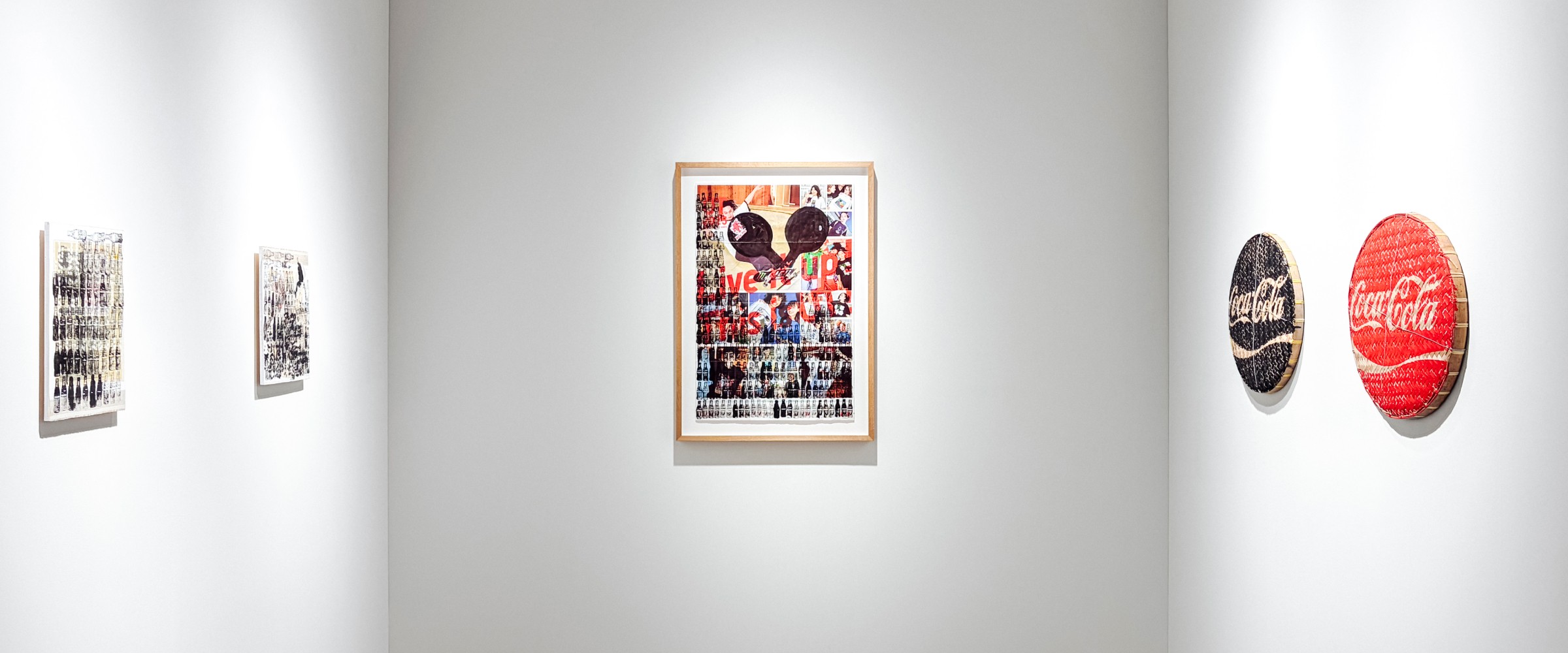
In June 2026, Krisanamis brought this ongoing investigation to Art Basel in Basel, where STPI presented a solo booth of new works developed through his residencies at the STPI Workshop in Singapore. Created in collaboration with the workshop’s master printers and papermakers, the works extend his longstanding engagement with mass media, popular culture and image circulation into an exploration of consumption, reproduction and the sensory overload of contemporary life.
Drawing on the visual language of mass culture and Pop Art, Krisanamis transforms recognisable commercial symbols and everyday objects through collage, stamping, assemblage and papermaking. Coca-Cola bottles, commercial labels, craft materials and other familiar forms are disrupted and reconfigured, shifting from recognisable icons into patterns, fragments and accumulated objects. The result is a playful yet pointed meditation on how images circulate, acquire meaning and shape contemporary experience.
For STPI Executive Director Emi Eu, the presentation offered an opportunity to place print and paper within the wider international contemporary art conversation. STPI became the first gallery from Singapore to participate in Art Basel in Basel in 2013 and has since maintained a sustained presence at the fair. The 2026 presentation brought Krisanamis’ practice into an international context, demonstrating how experimentation with print and paper can open new material and conceptual possibilities for an established artistic language.
The collaboration also reflects a defining principle of STPI’s residency programme: experimentation through exchange. Rather than simply translating an existing studio practice into print, artists work alongside specialist printers and papermakers to discover processes, materials and possibilities that can fundamentally reshape the work. As Eu describes it, “Every residency is a process of experimentation.” For Krisanamis, the encounter opened materials and techniques that could not have been explored in the same way within his own studio.
That spirit of experimentation runs throughout Krisanamis’ career. After moving from Bangkok to the United States in the early 1990s, he taught himself English through daily newspapers, crossing out words he already understood and gradually isolating unfamiliar ones. What began as a practical exercise became the basis of a distinctive visual language: grids, circles, erased language and accumulated fragments that transformed the newspaper from a source of information into an image in itself. That vocabulary continues to reverberate in his recent work, where the dots that emerged from redacted newspaper text become dense, almost glitch-like fields of information.
Decades later, that relationship with information remains central to his work. Familiar references—from music and advertising to everyday objects—are fragmented and reconfigured, becoming simultaneously recognisable and elusive. The resulting works are playful but pointed: familiar images of consumption are made strange, inviting viewers to consider not only what they recognise, but how and why those images acquire cultural meaning.
The conversation between Krisanamis and Eu moves between artistic practice, migration, identity, institutional support and the role of experimentation in contemporary art. Both have built careers across different cultural contexts: Krisanamis between Thailand, the United States and now Chiang Mai; Eu across South Korea, the United States, Europe and Singapore. Their experiences offer different perspectives on how movement can shape the way we see, make and connect.
They also consider what institutions can offer artists at a time when meaningful experimentation can be difficult to sustain. For both, time, collaboration and the freedom to take risks remain essential. For emerging artists and cultural practitioners, their advice is similarly grounded: stay curious, remain open to unexpected encounters, and resist the pressure to define a practice too quickly.
Looking beyond Art Basel, the collaboration continues. Krisanamis’ new body of work will form the basis of an institutional presentation at STPI in Singapore in 2027, extending the material and conceptual discoveries that began during his residencies. For an artist whose work has always been concerned with transformation, the Art Basel presentation is therefore not an endpoint, but another stage in an ongoing process of looking, making and discovering.
In this conversation, Udomsak Krisanamis and Emi Eu speak with CNTRFLD.ART about printmaking, popular culture, consumption, migration, identity, collaboration and what it means to keep experimenting in contemporary art.


