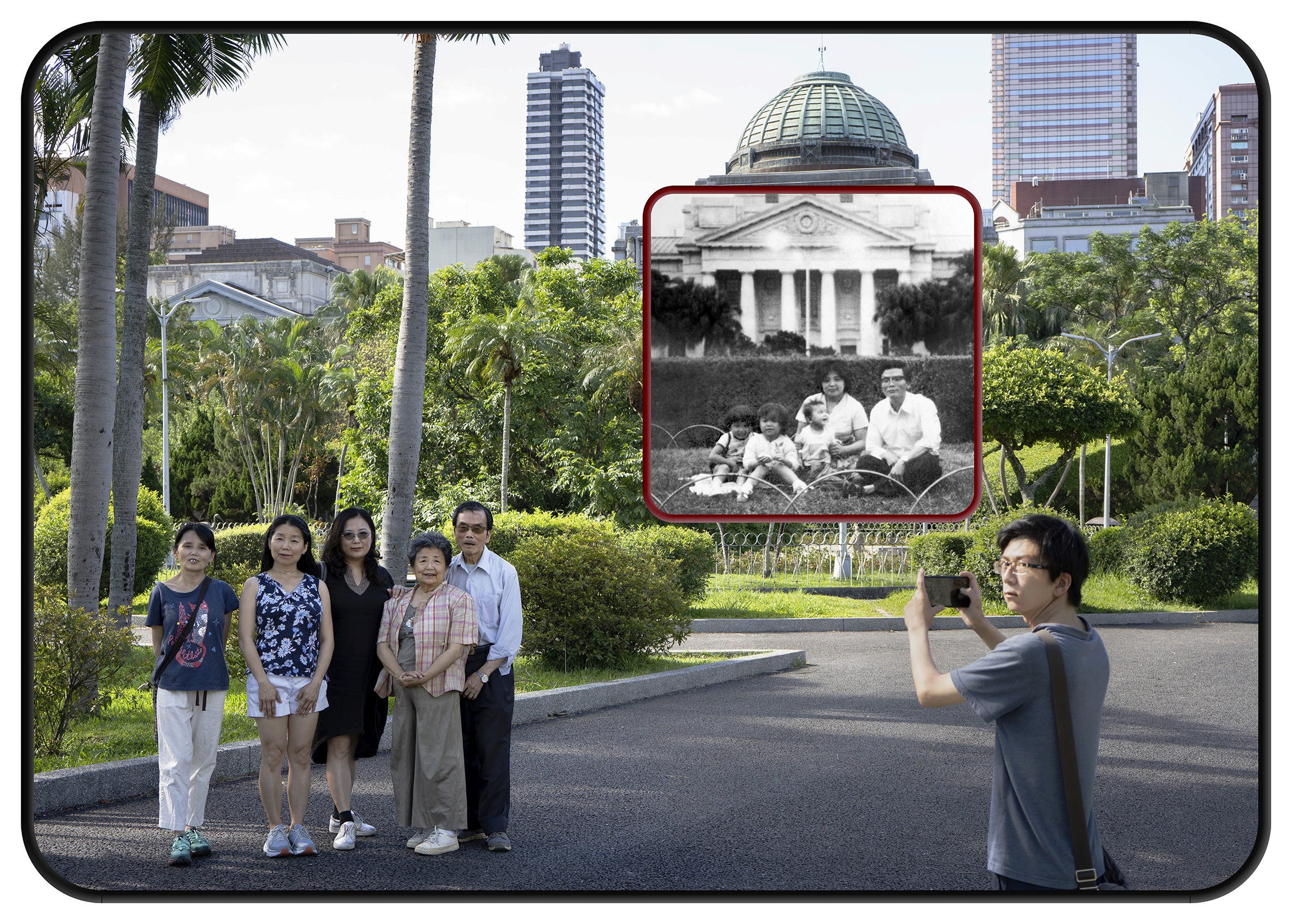
Annie Hsiao-Ching Wang illustrated by Maria Chen

DATE

2020/09/25

ARTICLE

Maria Chen

PHOTOS

Courtesy of the Artist

Annie Hsiao-Ching Wang: The Mother as a Creator and the Art of Time

he Taiwanese artist reflects on two decades of motherhood, photography and female identity—from The Mother as a Creator to Keep Going (2026)

For more than two decades, Taiwanese artist Annie Hsiao-Ching Wang has used photography to explore motherhood, female identity, memory and the passage of time. What began during her PhD at the University of Brighton as an intimate photographic record of her relationship with her son has developed into The Mother as a Creator (2007–present), an evolving body of work in which mother and child are photographed year after year, allowing successive moments to accumulate into what Wang describes as a visual “time tunnel”. 

Wang’s wider practice extends this sustained attention to time through photography, painting and family archives. In My Taipei (2020–2026), seven interconnected oil paintings revisit more than five decades of memory and the changing city she calls home. Reunion with Our Past (2023) brings four generations together through photographs made across different periods, while her new photobook What will be, will be (2026) draws on more than 50 years of family photographs and digital archives to consider womanhood, memory, ageing and self-understanding.

Her latest The Mother as a Creator photograph, No. 13: Keep going (2026), marks a new stage in the relationship at the heart of the series. With her son now an adult and beginning to forge an independent life—including travelling alone to Japan—Wang approaches motherhood through a different kind of closeness: letting go, listening from a distance and continuing to offer encouragement. “You walk your path, and I’ll walk mine,” she writes. “We support each other and keep cheering each other on.” The phrase becomes an affirmation for Wang herself as she reflects on ageing, resilience and the importance of caring for her own physical and emotional wellbeing.

The work will be presented alongside the earlier photographs in Family Times, a Bristol Photo Festival exhibition bringing together Wang’s The Mother as a Creator with Liu Hsing Yu’s My Father and Mother. At Centrespace Gallery, the two artists consider family not as a fixed structure but as something continually reshaped by time, memory, care and changing social expectations. 

Across her practice, Wang transforms deeply personal material into questions with wider cultural resonance. Her experience growing up in Taiwan, where sons were traditionally valued over daughters, led her to question what it means to become a woman and, ultimately, a woman artist. After leaving a career as an elementary school teacher to undertake research in the UK, she returned increasingly to her own cultural history and lived experience, discovering that work rooted in a specific place and personal story could speak across geographical and cultural boundaries.

Today, Wang’s work has been exhibited internationally and is held in major museum collections. Yet its foundation remains remarkably intimate: a mother and son, family photographs, a changing city, the passing of generations, and the decision to keep making.

In this conversation with CNTRFLD.ART, Wang reflects on more than two decades of The Mother as a Creator, the transition from motherhood as daily care to a relationship between two independent adults, and the making of What will be, will be. She discusses Taiwanese identity, female authorship, sustaining an artistic practice, and the creative power of perseverance.

CREDITS

Header

Slider 1

Slider 2

Slider 3

Slider 4

“I was surprised to discover that creative work rooted in Taiwanese culture and personal experience could cross cultural and geographical boundaries, touching people from different countries and backgrounds.”— Annie Hsiao-Ching Wang

TIME, DURATION, AND TRANSFORMATION

CNTRFLD. Your long-running series The Mother as a Creator spans more than two decades, documenting both your son’s growth and your own evolution as an artist. Looking back now, what has this sustained commitment revealed to you about time—not only as subject matter, but as a material within your practice?

AW. The works I created documenting time not only showed me the accumulation of growth and the trajectory of my efforts, but also made me appreciate the value of perseverance, the importance of love, and the power inherent in creation itself. However, this also made me more acutely aware of the cruelty of time. It flows relentlessly, and what I once thought was distant—aging—is now pressing in. I have been forced to confront a proposition I once refused to face: life will inevitably lead to aging, withering, and change, and how should I coexist with this irreversible flow of time? Therefore, starting in 2020, I embarked on three creative projects, all closely related to time. 


NEW BOOK / NEW CHAPTER

CNTRFLD. Your new book, What will be, will be, arrives at an especially meaningful moment in your career. What did the process of shaping this publication allow you to see about your work that perhaps years of making alone did not?

AW. Using a continuous series of family photographs spanning over 50 years as an exploration of female self-identity is quite rare in photographic art.

The entire book is like an evolutionary history of Taiwanese photography.

A microcosm of the evolution of Taiwanese women's self-awareness.

It has continuously evolved the unique creative form of collaboration with family members.

It turns out my parents were both very good at capturing fleeting moments; they left behind a vast and precious collection of images that are significant to their time.

A nested, ever-recurring pattern of life.

In an era dominated by selfies and AI, this is an honest work that goes against the trend.

Breaking down the boundaries between art and everyday life. Expanding the public significance of the private sphere.

This is not just a family photography book, but a profound exploration of women's life experiences, time, memories, and self-understanding; it responds to the individual and reflects the times. I hope to influence lives with my own.


FROM MOTHERHOOD TO AUTHORSHIP

CNTRFLD. When you began this body of work during your PhD at University of Brighton, motherhood was rarely centred in contemporary art discourse. Today, conversations around care, labour, and female authorship have become much more visible. How do you reflect on that shift?

AW. I respond with a comment shared by visual arts researcher Joanna Fu after attending my book launch. She wrote:

During the book launch, Artist Annie Hsiao-Ching Wang said, "Annie Wang hasn't changed; it's the times that have." Just as her work, “The Mother as a Creator”, resonates so widely internationally today, it's not only because of the work's maturity, but also because the current era is beginning to re-examine motherhood, aging, the body, and female subjectivity. In art history, many works have experienced the same fate: they haven't changed; it's the times that have caught up with them.


IDENTITY / TAIPEI / TRANSNATIONAL LENS

CNTRFLD. Born and raised in Taipei, and having lived and worked across Taiwan, the UK, and international art contexts, how has your understanding of identity evolved? Are there aspects of your work that you feel are deeply rooted in Taiwanese cultural experience, even when read globally?

AW. I grew up in a culture deeply rooted in traditional gender bias, where sons were valued more than daughters. From an early age, I often thought, “If only I had been a boy.” This thought led me on a journey to discover and understand my identity as a woman. As a young woman, I gradually moved from confusion about my gendered experience to actively asking: How can I become a woman who is treated equally and fairly? Along the way, I began to ask another question: How can I truly become a woman artist?

In search of answers, I gave up my career as an elementary school teacher and went to the United Kingdom—one of the important centres of feminism and women’s art—to conduct research. I wanted to understand the barriers Western women artists had overcome, and how they continued to move toward greater freedom and equality in the arts.

Over time, however, I came to realize that an individual’s power is limited. I therefore turned much of my energy back to Taiwan, drawing from my own cultural background and life experiences. The important slogan of second-wave feminism in the late 1960s and 1970s, “The Personal is Political,” gave me the courage and confidence to look deeply into my own experiences. Through my body, memories, emotions, and personal history, I began to reflect on the social environment and cultural structures that had deeply shaped me, as well as the choices and responses I made within them.

For me, art is not only a form of personal expression; it is also a way of starting from one’s own experience and engaging in dialogue with society. I originally sought to understand my own experience as a Taiwanese woman, but I was surprised to discover that creative work rooted in Taiwanese culture and personal experience could cross cultural and geographical boundaries, touching people from different countries and backgrounds.


MOTHERHOOD AFTER THE CHILD BECOMES ADULT

CNTRFLD. Much of The Mother as a Creator began through the intimate mother-child relationship. Now that your son has entered adulthood, how has your understanding of motherhood changed? Has the work also become, in some sense, about letting go?

AW. After having a child, motherhood becomes a lifelong commitment. But different stages present different challenges and lessons. As my son approached adulthood, letting go and encouraging his independence became crucial. The Mother as a Creator project was originally conceived to end after he reached adulthood. 

However, we both felt that the series had already achieved and surpassed its original purpose, and it was time to stop. Yet, the aspect of “Time” has gained even greater value due to 20 years of continuous shooting, so I wanted to continue until I were old, a point I discussed with my son. He said, "As long as I have time, I'm willing to continue shooting together." So, even after he became an adult and left home for school or work, we continued, though scheduling time together for shooting became increasingly difficult. 

In 2026, during his vacation, we finally shot a new work, The Mother as a Creator No. 13: Keep Going! This photograph, along with the previous 12, will be publicly exhibited for the first time at the Bristol Photo Festival in October 2026.

CREDITS

Divider

Image 1

Image 2

Image 3

Image 4

Image 5

VISIBILITY AND TRANSLATION

CNTRFLD. Your work has been exhibited across Asia, Europe, and the United States—from AIPAD Photography Show to Paris Photo and Getxophoto Festival. Have you noticed meaningful differences in how audiences from different regions read your work—particularly around motherhood, gender, and female agency?

AW. Different countries, backgrounds, age groups, and genders elicit different reactions.

In terms of national context, curators, critics, and scholars in Europe and USA tend to directly address the core issue—redefining motherhood—and use it to invite exhibitions and write papers. However, over time, more and more young women and artists are responding in this way, often sharing with me in person or on social media how they are moved and inspired. Even more encouraging is the emergence of young male scholars in Taiwan researching issues of women and motherhood, specifically including this work as a key research subject.

Meanwhile, feedback from most Asians or male audiences from different countries, focused more on the themes of "love," "family," and "time" in the work.

(Furthermore, my work was initially not accepted or understood by most people. My first British doctoral advisor (a woman) criticized it. She said, "Who cares about the story of an Asian woman becoming a mother?" And the elders in my hometown also find it hard to look at my work directly because they cannot accept a disobedient pregnant woman with her belly exposed.)

ECOSYSTEM / MENTORSHIP / INSTITUTION BUILDING

CNTRFLD. Beyond your practice, you are also an educator and founder of Ching Tien Art Space. In your experience, what kinds of support systems are most essential for artists to sustain meaningful work over the long term?

AW. An artist needs financial support to survive. For someone like me who creates art for myself, rather than for commercial purposes or commissions, making a living is extremely difficult. Therefore, I use another skill I have (education) to support my work. People need me to teach art, so I can exchange my teaching expertise for money to fund my creative endeavours. My work was initially unappreciated, and since my employer is myself, I had to earn money to pursue my art. Of course, family support and applying for government grants are also crucial for artists.

I quite enjoy teaching art and maintaining creative interactions with my students. I'm also grateful for their recognition, which allows me to pursue my art without much financial pressure while teaching. Emotionally, teaching provides very immediate feedback, reducing the frustration of creative work; while the feedback from creative work is slower, it brings me a deeper and greater sense of satisfaction and accomplishment.

RESISTANCE, ARCHIVE, OR LOVE?

CNTRFLD. Your work resists idealised narratives of motherhood and embraces contradiction, tenderness, labour, and transformation. Looking back today, do you see The Mother as a Creator primarily as an act of resistance, an archive of lived experience, a gesture of love—or something else entirely?

AW. The Importance of Creativity

Time and accumulation can create unpredictable power.

Rebellion doesn't necessarily require taking to the streets; we can influence others through sharing and understanding of life.

The wisdom of perseverance and resilience.

INSTITUTIONAL RECOGNITION AND RESPONSIBILITY

CNTRFLD. Your work is now held in major collections including the Victoria and Albert Museum, George Eastman Museum, and Nelson-Atkins Museum of Art. Has institutional recognition changed your relationship to your work—or your sense of responsibility as an artist?

AW. From initial rejection to recognition from several important art institutions, the journey has been filled with struggles and setbacks.

When I realized that my work and life's struggles could have an impact, I didn't feel superior. Instead, I felt I needed to dedicate more time to creating, exhibiting, and lecturing, doing my best to communicate with people through my art, making groundbreaking insights useful examples, and enriching our life with creativity and value.

ADVICE TO WOMEN ARTISTS

CNTRFLD. For women artists—or anyone navigating caregiving, family expectations, and creative ambition—what have you learned about building a practice that remains both sustainable and deeply personal?

AW. 我學到了如何使用零碎的時間,如何有彈性的處理自己堅持,如何堅持與尋求協助來保有自己的空間、時間和收入。最重要的,我學到如何愛自己,才懂得愛人,因為有了正確的愛,才能讓愛不偏激。

I learned how to use spare time, how to flexibly manage my convictions, and how to maintain my own space, time, and income by persisting and seeking help. Most importantly, I learned how to love myself in order to understand how to love others, because only with the right kind of love can love remain balanced and not extreme.

Image 1

Image 2

Image 3

Image 4

Image 5

Image 6

Image 7

Image 8

CREDITS

Image 1

Image 2

Image 3

Image 4

Image 5

Image 6

Image 7

Image 8

About the Artist

Annie Hsiao-Ching Wang (b. 1972, Taipei) is a Taiwanese artist whose multidisciplinary practice explores female identity, motherhood, time and the relationship between personal and collective memory. Working across photography and painting, she frequently draws on family archives and lived experience to examine gender, care, ageing and the evolving role of women in society.

Wang holds a PhD in Art from the University of Brighton and is an Assistant Professor at National Dong Hwa University. She is also the founder and director of Ching Tien Art Space.

Her work has been presented internationally at Images Vevey, Daegu Photo Biennale, Photo Australia, AIPAD, Paris Photo and Getxophoto, among others. Her photographs are held in the permanent collections of institutions including the Museum of Fine Arts, Houston; The J. Paul Getty Museum; George Eastman Museum; Nelson-Atkins Museum of Art; Harry Ransom Center; San Francisco Museum of Modern Art; and Tainan Art Museum. 

Her work has also received international critical attention, including coverage by The New Yorker and the BBC, particularly for its challenge to conventional representations of motherhood.


Exhibition Details

Family Times

Annie Wang & Liu Hsing Yu

Bristol Photo Festival 2026 — Time Machine

16 October – 11 November 2026
Centrespace Gallery
6 Leonard Lane
Bristol BS1 1EA, UK

Family Times brings together Annie Wang’s The Mother as a Creator and Liu Hsing Yu’s My Father and Mother, exploring how family relationships are continually reshaped by time, memory, care and changing social expectations. 

Wang’s The Mother as a Creator brings together seventeen years of photographic collaboration between mother and son, with successive images creating a visual “time tunnel” in which different moments of their relationship coexist. 

The exhibition forms part of the 2026 Bristol Photo Festival, whose opening week runs from 14–18 October 2026. Wang and Liu Hsing Yu will also participate in the Festival Symposium at Arnolfini on 16 October, alongside artists and speakers from across the festival programme. 


Exhibition dates: 16 October – 11 November 2026
Centrespace Gallery, 6 Leonard Lane, Bristol BS1 1EA 

Bristol Photo Festival — Family Times

Share Article

Share Article

More to Read

©2026

CNTRFLD.ART

UK Charity | HMRC Ref: ZD67011